Act I · THE SEEDS OF THOUGHT (1936–1980)
0%
The Complete Story of Synthetic Intelligence

THE LAST
INVENTION.

The epic chronicle of synthetic minds, the pioneers who built them, and the intelligence that will reshape human destiny.

Begin
Prologue · The Question at the Edge of the World

Before humanity could construct a machine that thought, it had to endure a far more destabilizing realization: that thinking itself might not be a mystical breath of divine fire, but a physical architecture.

For three hundred thousand years, Homo sapiens occupied an unchallenged pinnacle. We were not the swiftest predators across the Pleistocene savannah, nor were we gifted with the crushing physical power of the mastodon or the razor claws of the great carnivores. But our species possessed a singular biological superpower: recursive symbolic abstraction. Encased within our skulls was a three-pound, glucose-burning biological neural network capable of generating high-fidelity internal simulations of reality. We could close our eyes, populate an imaginary space with causal variables, test hypotheses in counterfactual daydreams, and then project those models outward to manipulate physical nature.

The flint spearhead, the cart wheel, the ceramic kiln, the movable-type printing press, the atmospheric steam engine, and the atomic fission reactor were all outward physical crystallizations of this internal modeling capacity. Every tool humanity ever fashioned was an amplifier for physical limitation. The lever multiplied the forearm; the telescope extended biological optical reach across cosmic light-years; the telegraph shot the human voice through ocean abysses at the speed of light.

Yet across all those millennia of technological acceleration, the overseer remained unchanging: the human mind. The machine was always the instrument; man was always the purpose.

Then, amid the smoldering debris of the twentieth century’s greatest industrial bloodbath, an eclectic collection of British and American mathematicians, cryptanalysts, neurophysiologists, and electrical engineers posed a question that struck at the heart of human uniqueness:

Can a physical machine be organized in such a manner that it learns, reasons, adapts, perceives, and invents?

The answer did not arrive in an instantaneous eureka moment. It unfolded across eighty years of intellectual warfare, ideological schisms, bitter academic exiles, deep government freezes, and unprecedented gambles on silicon hardware. It is a chronicle propelled by tragic geniuses who were broken by the very societies they saved, visionary heretics who defended neural concepts for decades while the academic establishment scoffed, and relentless corporate titans who wagered hundreds of billions of dollars on the premise that scaling compute and data would summon a synthetic mind.

This is the definitive chronicle of that ascent—from the mechanical logic of Bletchley Park to the frontier silicon gigafactories of today, and toward the threshold where synthetic intelligence outgrows the species that authored it.

ACT 01 1936–1980

Wartime urgency followed by pure theoretical ambition. Mathematicians and logicians shifted from asking whether a machine could calculate faster than a human to asking whether a machine could fundamentally think.

3 chapters · 10 min · 2,187 words

Inventions & products of the age
1942
The Bombe

Electromechanical decryption hardware used at Bletchley Park to systematically eliminate German Enigma cipher keys.

1950
The Turing Test

The foundational benchmark for machine intelligence, based on conversational indistinguishability.

1958
LISP

John McCarthy's high-level language for symbolic manipulation and early AI research.

1961
Unimate

A 4,000-pound robotic arm at General Motors moving die castings: the world's first industrial robot.

1964
ELIZA

A script-driven chatbot that mimicked a Rogerian psychotherapist by reflecting inputs back as questions.

1969
Shakey the Robot

The first general-purpose mobile robot able to perceive its environment, parse spatial goals, and plan paths.

Alan Turing and the Universal Engine

Chapter 1 · 4 min read

In the late spring of 1935, a twenty-two-year-old Cambridge mathematical fellow named Alan Turing lay breathless in the clover of Grantchester Meadows. He had just finished a punishing long-distance run along the River Cam. Turing was a solitary, eccentric athlete whose mind achieved clarity not in crowded seminar rooms, but in the rhythm of his own pounding heartbeat and solitary strides.

Lying in the grass, his mind turned over an arcane challenge that had cast a long shadow over European mathematics: the Entscheidungsproblem, or “decision problem,” posed in 1928 by David Hilbert. Hilbert had dreamed of establishing mathematics on an unshakeable foundation of complete, consistent, and decidable logic. He asked: Could there ever exist a mechanical, step-by-step procedure—an effective method, an algorithm—that could take any well-defined mathematical assertion and definitively decide whether it was provable?

In 1931, Kurt Gödel had shattered Hilbert’s first dream with his Incompleteness Theorems, proving that any formal axiomatic system capable of arithmetic contains truths that cannot be proven within the system itself. But the decision problem remained an open wound.

To resolve it, Turing did not draft an equation of conventional symbols. Instead, in his landmark 1936 paper, On Computable Numbers, with an Application to the Entscheidungsproblem, he constructed a thought experiment: an imaginary mechanical device.

Imagine an infinite strip of paper tape divided into discrete squares. A scanning head moves back and forth over the tape, reading symbols, erasing them, printing new ones, and shifting left or right according to a finite internal lookup table. Turing demonstrated that this theoretical apparatus—the Turing Machine—could execute any conceivable mathematical computation that could be broken down into finite mechanical steps.

More profoundly, Turing proved the existence of a Universal Turing Machine.

Prior to 1936, calculating machines were purpose-built artifacts. An adding machine could add; a mechanical loom wove patterns dictated by punched cards. If you wanted a machine to perform a different task, you had to physically alter its brass gears, levers, and circuits.

Turing turned that paradigm inside out. A Universal Turing Machine did not possess fixed internal functions. It was capable of reading the description of any other specific computing machine encoded as symbols upon its tape, simulating that machine’s actions step by step, and producing the identical result. In that single, astonishing theoretical leap, Alan Turing invented the concept of the general-purpose stored-program computer. The physical machine (the hardware) could remain entirely static; the instructions inscribed upon the tape (the software) would endow it with infinite behavioral variability. Turing then delivered the coup de grâce to Hilbert’s Entscheidungsproblem: he proved the undecidability of the Halting Problem, demonstrating that no general algorithm could ever inspect an arbitrary computer program and determine whether it would eventually halt or run forever.

When World War II broke over Europe in September 1939, Turing’s abstract logic was hurled into a mortal arena.

At Bletchley Park, the Victorian estate housing Britain’s Government Code and Cypher School, German military communications were encrypted by the Enigma machine—an electromechanical field cipher device equipped with rotating polyalphabetic rotors and a front plugboard generating roughly 158 quintillion (1.58×10201.58 \times 10^{20}) possible key settings daily. Human cryptanalysts were mathematically paralyzed.

Turing recognized an immutable law of the coming era: Only a machine can defeat a machine.

Working in Hut 8, Turing—collaborating with Gordon Welchman and Harold Keen—designed an industrial electromechanical behemoth known as the Bombe. Measuring seven feet tall and weighing over a ton, the Bombe consisted of thirty-six miniature Enigma simulators spinning on bronze shafts. Operating on “cribs”—short stretches of intercepted ciphertext where cryptanalysts could guess probable underlying words like German weather reports (“WETTERVORHERSAGE”)—the Bombe used electrical circuits to search for logical contradictions, eliminating quintillions of permutations in minutes.

Turing’s mechanical reasoner cracked the German Naval Enigma, allowing Allied commanders to track U-boat wolfpacks stalking Atlantic convoys. Historians estimate the intelligence produced at Bletchley Park shortened the war in Europe by more than two years and saved over fourteen million lives.

Yet even amid wartime secrecy, Turing’s gaze was fixed on a more expansive horizon: the nature of intelligence itself.

In 1950, working at the University of Manchester, Turing published a paper in Mind that permanently altered human self-perception: Computing Machinery and Intelligence.

Its opening sentence was an intellectual broadside:

“I propose to consider the question, ‘Can machines think?’”

To bypass semantic quicksand, Turing proposed the “Imitation Game,” forever remembered as the Turing Test. A human interrogator in an isolated room communicates via text with two hidden respondents: one human, one computer. If the interrogator cannot reliably distinguish between them after five minutes of interrogation, Turing asserted it was intellectually dishonest to deny that the machine was demonstrating functional intelligence.

Turing systematically demolished every counterargument: Lady Lovelace’s claim that machines cannot originate anything, the argument from consciousness, and theological objections. He predicted that by the year 2000, computers with a gigabyte of storage would play the imitation game so convincingly that an average interrogator would have no more than a seventy percent chance of correct identification.

Turing did not live to see his prophecy fulfilled. In 1952, he was arrested and convicted under Britain’s anti-homosexuality statutes, stripped of security clearances, and subjected to chemical castration. On June 7, 1954, forty-one-year-old Alan Turing was found dead beside an apple laced with potassium cyanide. The man who laid the foundations of digital civilization had been broken by the nation he preserved.
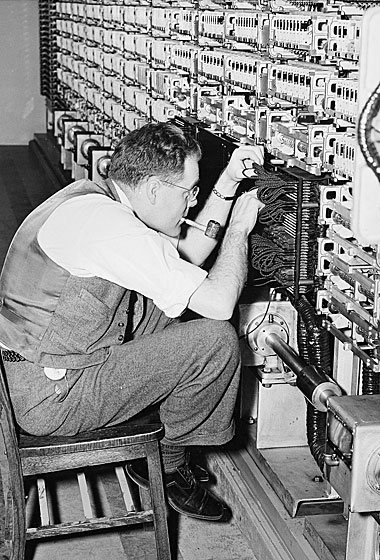
Black-and-white photograph of a technician in a waistcoat, pipe in mouth, working on the wiring of a tall relay-switching rack.
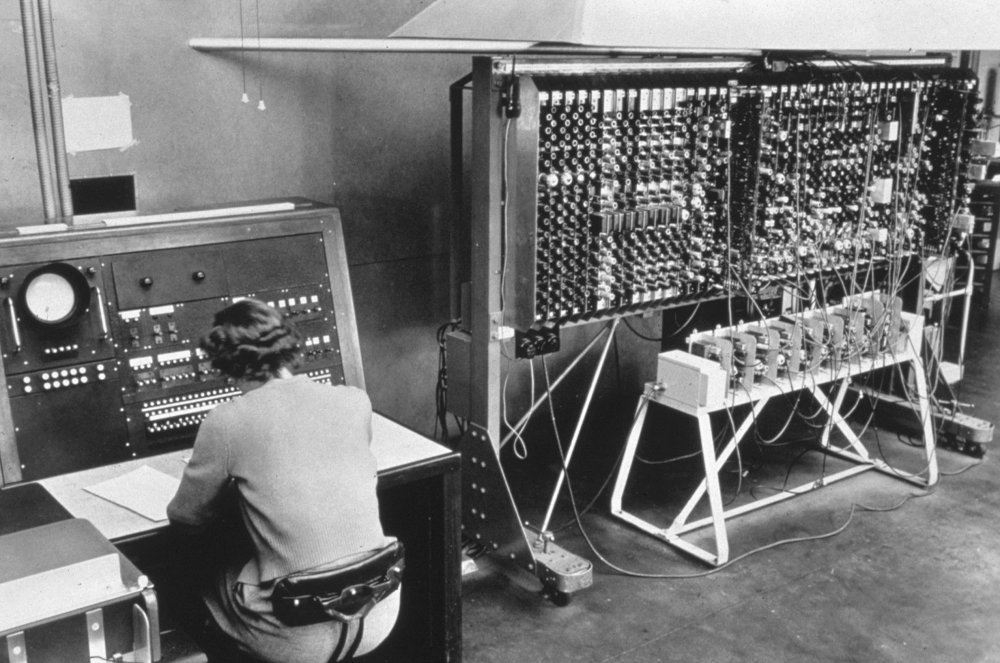
Black-and-white photograph of an operator seated at the control desk of an early electronic computer, beside a large rack of valves and patch wiring.
Relays, valves & patch cordsThe physical machinery of early computing

McCulloch, Pitts, and the First Neural Net

Chapter 2 · 3 min read

While Turing approached machine intelligence from the summit of mathematical logic, two men in Chicago mounted an assault from the opposite direction: bottom-up, through the tangled biology of the brain.

In 1943, eccentric neurophysiologist Warren McCulloch and homeless teenage mathematical prodigy Walter Pitts published a paper that founded the field of Artificial Neural Networks (ANNs): “A Logical Calculus of the Ideas Immanent in Nervous Activity.”

Their partnership was one of the most improbable in the history of science. McCulloch was a bohemian patriarch who slept four hours a night, drank whiskey, and debated metaphysics. Pitts was a shy, neglected runaway from the slums of Detroit who had spent his childhood hiding in public libraries. At twelve, Pitts read Bertrand Russell and Alfred North Whitehead’s Principia Mathematica, sent Russell a letter pointing out several subtle logical errors, and received an invitation to Cambridge. Lacking funds, Pitts ran away to Chicago at fifteen, living on pennies and auditing lectures in silence until McCulloch took the destitute prodigy into his household.

McCulloch and Pitts shared an intoxicating conviction: that the brain’s power did not stem from some mystical vitalistic soul, but from an underlying computational grammar.

Examining neurophysiological discoveries, they recognized that a biological neuron is essentially a binary threshold switch. Dendrites receive electrochemical pulses across synaptic clefts. If the aggregate sum of excitatory signals exceeds an inhibitory threshold at the axon hillock, the neuron depolarizes, firing an action potential down its axon. If it falls short, it remains inert. Zero or one. True or false.

They constructed an idealized mathematical abstraction of a neuron. Each artificial node received multiple binary inputs (x1,…,xnx_1, \dots, x_n). Each input was multiplied by a fixed connection weight. The node summed these inputs; if the total sum exceeded a predetermined threshold θ\theta, the node emitted a 1; otherwise, it emitted a 0.

Output={1if ∑i=1nwixi≥θ0otherwise\text{Output} = \begin{cases} 1 & \text{if } \sum_{i=1}^n w_i x_i \ge \theta \\ 0 & \text{otherwise} \end{cases}

With rigorous mathematical proofs, McCulloch and Pitts demonstrated that by wiring networks of these threshold units together in feedforward and feedback loops, one could compute any logical truth table: AND, OR, NOT. If a function could be computed by a finite Turing Machine, it could be implemented by an artificial neural network. The human mind was an electrical network computing its own reality.

Yet the McCulloch-Pitts model could not learn; its weights were hand-wired into place by an external designer.

Fifteen years later, in 1958, an ambitious research psychologist at the Cornell Aeronautical Laboratory in Buffalo, New York, set out to breathe life into those static circuits: Frank Rosenblatt.

Rosenblatt, a charismatic polymath who studied cognitive psychology, astronomy, and biology, believed passionately that human intelligence could not be replicated through rigid top-down programming. Backed by funding from the US Office of Naval Research, Rosenblatt unveiled the Mark I Perceptron.

The Perceptron was an imposing physical machine of custom electrical hardware. Its “eye” consisted of an optical focal plane containing four hundred cadmium-sulfide photocells arranged in a 20x20 grid, mimicking the human retina. These photocells were wired through tangled cables to potentiometers—variable resistors driven by small electric servomotors. These potentiometers represented synaptic weights.

When the Perceptron was presented with an image—for instance, a white cardboard square with an ‘X’ or an ‘O’ stenciled onto it—photocells detected light patterns and transmitted electrical currents through the potentiometers to summing units. If the machine produced an incorrect classification, an operator did not rewrite code.

Instead, Rosenblatt instituted the Perceptron Learning Algorithm.

The machine applied electrical negative feedback: servomotors physically rotated the potentiometer dials. If a connection contributed to a false positive, its dial turned to increase electrical resistance, weakening the link; if it contributed to a correct signal, it strengthened. The Mark I Perceptron was learning directly from sensory experience through iterative trial and error.

In July 1958, The New York Times reported on Rosenblatt’s demonstration under a breathless headline:

“The Navy revealed the embryo of an electronic computer today that it expects will be able to walk, talk, see, write, reproduce itself and be conscious of its existence… The machine would be the first non-biological system capable of what he called ‘an original idea.’”

Rosenblatt toured the country giving charismatic lectures, predicting that perceptrons would soon navigate spacecraft, read handwritten manuscripts, and diagnose complex medical diseases. But his meteoric rise ignited fierce intellectual hostility from the high priests of mathematical logic.

Chapter 3 · 2 min read

Two years before Frank Rosenblatt unveiled the Perceptron, during the hot summer of 1956, twenty scientists met on the top floor of Dartmouth Hall in Hanover, New Hampshire.

The gathering was organized by assistant mathematics professor John McCarthy, joined by Marvin Minsky, Claude Shannon, and Nathaniel Rochester. Their funding proposal to the Rockefeller Foundation gave the field its permanent name:

“We propose that a 2 month, 10 man study of artificial intelligence be carried out during the summer of 1956 at Dartmouth College… The study is to proceed on the basis of the conjecture that every aspect of learning or any other feature of intelligence can in principle be so precisely described that a machine can be made to simulate it.”

Dartmouth established the reign of Symbolic AI (GOFAI). McCarthy, Minsky, Allen Newell, and Herbert Simon believed human cognition was fundamentally the formal manipulation of discrete physical symbols according to rules of deductive logic: If Socrates is a man, and all men are mortal, Socrates is mortal.

To the symbolic camp, connectionist neural networks looked like crude alchemy. Why tinker with messy analog voltages and noisy potentiometer dials when you could write pristine, transparent rules of formal logic?

The philosophical rift hardened into a fierce turf war for prestige and federal defense research grants. At the center of the conflict stood Marvin Minsky.

Minsky, who co-founded the prestigious MIT Artificial Intelligence Laboratory in 1959, had actually built one of the earliest primitive vacuum-tube neural net simulators—the SNARC—as an undergraduate in 1951. Having built it, Minsky concluded that neural networks were a computational dead-end: intractable, impossible to inspect, and fundamentally incapable of higher-order reasoning.

In 1969, Minsky joined forces with mathematician Seymour Papert to publish a devastating mathematical treatise: Perceptrons: An Introduction to Computational Geometry.

Minsky and Papert analyzed the exact geometric limitations of single-layer perceptrons, delivering their lethal demonstration on the Exclusive-OR (XOR) function.

An AND gate outputs 1 only when both inputs are 1. An OR gate outputs 1 when either input is 1. Both functions are linearly separable: on a two-dimensional Cartesian plane, a single straight line easily divides the positive from negative coordinates. But the XOR function outputs 1 if either input is true, but 0 if both are true or both are false. When plotted, the positive outputs sit on opposite diagonal corners. It is mathematically impossible to draw a single straight line that separates the classes. The XOR function requires at least one intermediate hidden layer to warp the coordinate space.

Crucially, Minsky and Papert conjectured that extending perceptrons into multi-layered architectures was mathematically sterile, arguing that there existed no viable algorithm to train the hidden weights without hitting combinatorial explosion.

The effect was catastrophic. Defense agencies slammed their checkbooks shut. In 1973, Sir James Lighthill delivered his scathing Lighthill Report to the British Science Research Council, concluding that AI had failed to achieve its grand promises. Government funding for neural networks evaporated across the United States, Britain, and Europe.

To mention “neural networks” in an academic proposal became professional suicide. On his forty-third birthday in July 1971, Frank Rosenblatt drowned in a boating accident in Chesapeake Bay, believing his life’s work had been permanently discredited.

The First AI Winter descended. The laboratories fell dark. But deep in the academic underground, a tiny band of stubborn heretics refused to abandon the dream.

ACT 02 1980–2010

After the computational stalls of the AI winters came a commercial and algorithmic comeback: sophisticated pattern matching, domain-specific rule evaluation, and affective human-computer interaction.

4 chapters · 13 min · 3,001 words

Inventions & products of the age
1995
ALICE

A heuristic natural-language bot, built on AIML, that expanded open-domain chat.

1997
IBM Deep Blue

A 32-node supercomputer that defeated World Chess Champion Garry Kasparov under tournament time controls.

1998
Kismet

An expressive robotic head built to explore social, auditory, and facial dynamics between humans and machines.

2002
iRobot Roomba

An autonomous domestic vacuum driven by tactile bumpers and infrared sensors.

Geoffrey Hinton and Backpropagation

Chapter 4 · 4 min read

If symbolic logic was a cold cathedral carved from rigid marble, human cognition was something far messier: a dense, humid, pulsing rainforest of eighty-six billion biological neurons, constantly tuning trillions of electrochemical synaptic junctions in response to a torrent of messy sensory noise.

No one felt the truth of this biological intuition more deeply than Geoffrey Hinton.

Born in post-war Britain in December 1947, Hinton was scientific royalty. His great-great-grandfather was George Boole, the self-taught mathematical genius who invented Boolean algebra—the foundation of digital logic gates. His father was an eminent entomologist; his relatives included Manhattan Project physicist Joan Hinton.

Yet young Geoffrey was plagued by an almost romantic dissatisfaction with standard academic reductionism. He wanted to understand the mind, but every discipline he tried felt inadequate. He studied natural sciences at King’s College, Cambridge, dropped out, studied the history of art, quit, tried philosophy, found it sterile, and briefly worked as a carpenter in North London, building custom cabinets with his hands. Wood was honest; it yielded to a sharp chisel. Academic psychology, by contrast, seemed obsessed with measuring reaction times while ignoring the physical mechanism that produced them.

In 1973, Hinton found his way to the University of Edinburgh to pursue a doctorate in artificial intelligence under Christopher Longuet-Higgins. Edinburgh was one of the few places where neural networks had not been completely snuffed out by Minsky and Papert’s Perceptrons. Even so, his advisor repeatedly pressured him to abandon connectionism for symbolic logic. Hinton refused. He was stubborn to the point of obsession: he believed that if the human brain computed using billions of parallel interconnected neurons, then symbolic rules were merely a fragile epiphenomenon floating on top of a continuous neural substrate.

Hinton recognized the fundamental flaw in Minsky and Papert’s dismissal of multi-layer networks. Multi-layer networks could solve non-linear problems like XOR. In fact, they could theoretically approximate any continuous mathematical function—a reality later formalized as the Universal Approximation Theorem.

The entire roadblock boiled down to a single, agonizing mathematical challenge: The Credit Assignment Problem.

Imagine a neural network with an input layer, two intermediate hidden layers of synthetic neurons, and an output layer. You feed in the digitized frequencies of a spoken vowel. The network makes a prediction: it guesses “OH” instead of “AH.” An error has occurred.

In a single-layer perceptron, credit assignment is trivial because the weights connect directly to the output. But in a deep network, the output is the cumulative result of hundreds or thousands of intermediate weights interacting across multiple hidden layers. How do you know which specific hidden weight was responsible for the error? Did neuron #34 in hidden layer 1 fail to detect a formant frequency? Did neuron #82 in hidden layer 2 improperly suppress a threshold? If you cannot assign blame, you cannot adjust the weights.

The solution required abandoning the discrete, all-or-nothing step functions of McCulloch and Pitts.

Hinton realized that if you replaced the binary step threshold with a smooth, continuous, S-shaped mathematical curve—a sigmoid activation function (σ(z)=11+e−z\sigma(z) = \frac{1}{1 + e^{-z}})—the network became mathematically differentiable everywhere. Every tiny nudge to an input weight produced a tiny, predictable change in the output.

σ(z)=11+e−z\sigma(z) = \frac{1}{1 + e^{-z}}

And because the network was differentiable, you could unlock the supreme power of differential calculus: the Chain Rule.

Working in collaboration with cognitive psychologist David Rumelhart at UC San Diego and statistician Ronald Williams, Hinton popularized the algorithm that would become the beating heart of modern artificial intelligence: Backpropagation.

The algorithmic breakthrough was unveiled in a seminal 1986 paper published in Nature: Learning representations by back-propagating errors.

The mechanics of backpropagation were as elegant as they were powerful:

  1. The Forward Pass: An input vector propagates forward through hidden layers: each neuron computes a weighted sum of its inputs, adds a bias, and applies its non-linear activation function. Finally, the output layer emits a prediction.
  2. The Loss Evaluation: A mathematical loss function measures the distance between the network’s prediction and the true ground-truth label, generating a scalar error value.
  3. The Backward Pass: Using the chain rule of calculus, the algorithm calculates the partial derivative of the loss function with respect to every single weight in the network, working backward from the output layer through the hidden layers:
∂L∂wij=∂L∂yj⋅∂yj∂zj⋅∂zj∂wij\frac{\partial \mathcal{L}}{\partial w_{ij}} = \frac{\partial \mathcal{L}}{\partial y_j} \cdot \frac{\partial y_j}{\partial z_j} \cdot \frac{\partial z_j}{\partial w_{ij}}

This partial derivative represents the gradient: it tells you exactly how much the total error will shift if you adjust that specific weight by an infinitesimal amount.
4. Gradient Descent: The algorithm updates every weight by taking a small step in the direction opposite to the gradient, scaled by a learning rate (η\eta):

wnew=wold−η∂L∂ww_{new} = w_{old} - \eta \frac{\partial \mathcal{L}}{\partial w}

Backpropagation proved that multi-layer neural networks did not depend on human engineers to hand-craft features. Given training data and backpropagated errors, the hidden layers spontaneously organized their own internal representations. In their 1986 paper, Hinton demonstrated that a network trained on family kinship relationships spontaneously invented hidden neurons that corresponded to abstract concepts like “generation” and “family branch”—concepts nobody had explicitly programmed.

Yet the triumph was short-lived. When researchers attempted to scale backpropagation to truly deep networks—networks with five, ten, or twenty hidden layers—the mathematics broke down under the Vanishing Gradient Problem.

Because the derivative of the sigmoid function is always less than 0.25, multiplying these fractional derivatives together across multiple layers caused error signals to shrink exponentially as they traveled backward. By the time the gradient reached layer one, it had vanished into numerical insignificance: 10−610^{-6}, 10−1210^{-12}. The early layers remained frozen, unable to learn. Furthermore, critics pointed out that gradient descent was non-convex: there was no mathematical guarantee that the network would not get trapped in local minima.

In 1987, deeply opposed to the militarization of AI under the “Star Wars” Strategic Defense Initiative (which channeled DARPA funding into Carnegie Mellon), Hinton resigned from CMU and immigrated to Canada.

He accepted a professorship at the University of Toronto and secured support from the Canadian Institute for Advanced Research (CIFAR). Canada became the sanctuary where connectionism would survive the long winter.

Yann LeCun and the Convolutional Revolution

Chapter 5 · 3 min read

While Geoffrey Hinton was formalizing backpropagation, a young French electrical engineer across the Atlantic was staring at a biological puzzle: How does the mammalian eye make sense of visual reality?

His name was Yann LeCun.

Born in 1960 in the Parisian suburb of Soisy-sous-Montmorency, LeCun was an engineer with a passion for mechanical tinkering. While studying at ESIEE in Paris, he stumbled upon an old text describing Frank Rosenblatt’s Perceptrons in a university library. LeCun was captivated. While his professors dismissed neural nets as obsolete curiosities, LeCun spent his nights writing simulation programs on home-built microcomputers.

In 1987, after completing his doctoral thesis on backpropagation, LeCun worked as a postdoctoral fellow in Hinton’s Toronto laboratory before being recruited to the Adaptive Systems Research Department at AT&T Bell Laboratories in Holmdel, New Jersey.

Bell Labs was a paradise for scientific research. Armed with world-class computational resources, LeCun tackled an industrial challenge: the US Postal Service and NCR Corporation needed machines that could automatically read handwritten digits on postal envelopes and bank checks.

Standard feed-forward neural networks were catastrophic at processing visual imagery.

A 32x32 pixel image contains 1,024 pixels. In a fully connected network, connecting those pixels to 1,000 hidden neurons requires over one million synaptic weights for the first layer alone. Scale that to a modern megapixel photograph, and parameters explode into billions.

Worse, fully connected networks possessed zero spatial locality and zero translation invariance. If a handwritten ‘4’ was centered in the image, the network might recognize it. But if the digit shifted three pixels to the left, completely different input neurons fired. The network had no concept that an edge in the upper-left was geometrically identical to an edge in the lower-right.

LeCun found his breakthrough in neurobiology.

In 1959, Harvard neurophysiologists David Hubel and Torsten Wiesel discovered that the primary visual cortex (V1) of mammals is not fully connected to the retina. Instead, individual neurons have localized receptive fields: they respond exclusively to stimuli within a tiny patch of the visual field. Furthermore, they discovered a hierarchy: “simple cells” fired for basic oriented edges; “complex cells” aggregated signals to achieve translation invariance; and higher cortical areas assembled these primitives into complete shapes.

Drawing on Hubel and Wiesel’s neurophysiology and Kunihiko Fukushima’s early 1980 “Neocognitron,” LeCun introduced the definitive architecture for computer vision: the Convolutional Neural Network (CNN).

In 1989, culminating in his historic 1998 paper, LeCun, Léon Bottou, Yoshua Bengio, and Patrick Haffner unveiled LeNet-5 (documented at LeNet-5 Architecture).

LeNet-5 introduced three foundational architectural principles:

  1. Local Receptive Fields & Convolutional Kernels: Instead of connecting every pixel to every neuron, LeNet-5 slid small mathematical matrices called filters (e.g., 5x5 pixel grids) across the image, computing dot products to produce feature maps. A horizontal-edge filter lit up wherever horizontal lines appeared, regardless of their location.
  2. Shared Weights: The same 5x5 filter was applied across the entire image. This slashed trainable parameters by orders of magnitude: instead of thousands of unique weights for every pixel location, the network trained only twenty-five weights per feature map.
  3. Subsampling (Pooling) Layers: Following each convolutional layer, pooling layers downsampled spatial dimensions (e.g., taking the average or maximum value in a 2x2 window). This reduced computational complexity and bestowed translation invariance: small shifts or distortions of the digit did not disrupt classification.

The system was an extraordinary industrial triumph. Bell Labs packaged LeNet-5 into commercial check-reading machines deployed across banks throughout North America. By the late 1990s, LeCun’s network was reading ten to twenty percent of all handwritten checks in the United States.

Yet the broader computer science world once again turned its back on neural networks.

In the mid-1990s, Support Vector Machines (SVMs), pioneered by Vladimir Vapnik at Bell Labs, swept through machine learning. SVMs were grounded in convex quadratic optimization: they found the optimal maximum-margin hyperplane separating classes, with zero local minima and no heuristic hyperparameter tuning.

Academic journals began rejecting neural net papers. Following corporate breakups at AT&T, Bell Labs’ research budget was slashed. LeCun left Bell Labs, spent a brief stint at NEC, and retreated to academia as a professor of computer science at New York University (NYU).

The Second AI Winter had arrived.

Yoshua Bengio and Representation Learning

Chapter 6 · 2 min read

During this second prolonged drought, when publishing a paper mentioning “neural networks” guaranteed instant rejection from conferences like CVPR and NeurIPS, a mutual-support pact was forged across North America.

The community referred to them as the Deep Learning Conspiracy, and later, the Godfathers of AI: Geoffrey Hinton in Toronto, Yann LeCun in New York, and Yoshua Bengio in Montreal.

Born in Paris in 1964 and raised in Montreal, Yoshua Bengio was a scholar of quiet demeanor, uncompromising integrity, and ferocious mathematical rigor. After earning his PhD at McGill University in 1991 and working under Michael I. Jordan at MIT and alongside LeCun at Bell Labs, Bengio established his laboratory at the University of Montreal. He transformed this outpost into Mila (Quebec Artificial Intelligence Institute), which would grow into the largest academic concentration of deep learning researchers in the world.

While Hinton explored cognitive intuition and LeCun mastered vision, Bengio focused on the theoretical foundations of Representation Learning and sequential modeling.

In 2000, Bengio published a landmark paper: “A Neural Probabilistic Language Model.”

At the time, statistical natural language processing relied on n-grams: frequency tables measuring how often word sequences appeared together in text. N-grams suffered from the curse of dimensionality: if a specific triplet of words had never appeared in the training text, the model assigned it zero probability. The model had no concept that “the cat sat on the mat” was semantically similar to “the dog slept on the rug.”

Bengio proposed representing words as continuous mathematical vectors in a high-dimensional space—the foundation of modern word embeddings.

In Bengio’s vector space, words were mapped to coordinates of real numbers (d≈100d \approx 100). Crucially, words with similar meanings clustered together: “cat” was near “dog”; “king” was geometrically related to “queen.” By learning distributed, continuous representations, neural networks could generalize to word combinations they had never seen before.

Yet Bengio, Hinton, and LeCun faced a shared wall: their networks were starved.

In 2004, Hinton secured a modest grant from the Canadian Institute for Advanced Research (CIFAR) under the program title “Neural Computation and Adaptive Perception.” It provided unrestricted funding to Hinton, Bengio, LeCun, and a tight circle of collaborators.

For nearly a decade, this small band of CIFAR fellows met twice a year in secluded ski lodges in Quebec and rustic inns in Ontario. They were the intellectual underground, sharing code and debating the bottlenecks holding connectionism hostage:

  1. The Data Bottleneck: Neural networks are statistical sponges. A multi-layer network with millions of weights possesses immense capacity, but if you train it on a few thousand examples, it memorizes the data—a pathology called overfitting. In the 1990s, datasets contained only a few thousand blurry images.
  2. The Compute Bottleneck: Running backpropagation through millions of parameters required trillions of floating-point operations. Central Processing Units (CPUs) were masters of sequential execution: an Olympic sprinter executing complex, branched instructions with blazing clock speeds. But backpropagation did not need complex branching; it needed massive arithmetic: multiplying two giant rectangular matrices of numbers together, billions of times in parallel.

On CPUs, training deep networks took months. The algorithms were not wrong. They were simply trapped in silicon starvation.

Five thousand miles away, in Northern California, an immigrant chip designer was unintentionally forging the silicon furnace that would liberate them.

NVIDIA, CUDA, and the Matrix Miracle

Chapter 7 · 3 min read

In April 1993, three electrical engineers met in the red vinyl booth of a Denny’s diner in East San Jose, California: Curtis Priem, Chris Malachowsky, and a thirty-year-old Taiwanese-American microchip designer named Jensen Huang.

Huang’s path was an embodiment of immigrant resilience. Born in Tainan, Taiwan, in 1963, his parents sent nine-year-old Jensen and his brother to the United States. Due to a misunderstanding, his uncle enrolled the boys in the Oneida Baptist Institute in Kentucky—a strict religious reform academy. Young Jensen was assigned daily chores cleaning bathrooms; his roommate was an illiterate youth covered in knife scars. Huang didn’t complain; he scrubbed toilets with fanatical perfection, taught his roommate to read, and developed an unshakeable work ethic.

Later, while earning his electrical engineering degree at Oregon State, Huang worked as a dishwasher and busboy at Denny’s, learning to thrive in high-pressure environments. After earning a master’s at Stanford, he worked at LSI Logic and AMD designing microprocessors.

Sitting in that San Jose Denny’s over cheap drip coffee, the three engineers agreed on a vision: personal computing would be driven by immersive 3D graphics for video games. They pooled $40,000 in savings and founded NVIDIA.

Rendering real-time 3D virtual worlds for video games—calculating perspective projection, polygonal shading, and lighting for games like Quake and Half-Life—presented a computational challenge fundamentally different from desktop operating systems.

To render a 1080p screen sixty times per second, a computer must calculate the color values of two million pixels, sixty times every second: 120 million pixel calculations per second.

A CPU tackled this sequentially, with two, four, or eight high-powered cores. But when faced with millions of pixels simultaneously, even the most powerful CPU slowed to a crawl.

NVIDIA pioneered a radically different silicon philosophy: the Graphics Processing Unit (GPU), unveiling the GeForce 256 in 1999.

A GPU was an army of thousands of simpler cores marching in lockstep: a parallel juggernaut engineered for Single Instruction, Multiple Data (SIMD) operations. It executed the identical mathematical operation across thousands of data streams concurrently.

In 2006, Jensen Huang made an existential bet that nearly destroyed his company.

Huang envisioned Accelerated Computing. He believed the future of computing belonged to hybrid systems: CPUs running the serial operating system, GPUs accelerating massive parallel math.

Huang committed NVIDIA to engineering CUDA (Compute Unified Device Architecture)—a software platform that exposed the raw parallel cores of NVIDIA GPUs directly to standard programming languages like C and C++.

The financial toll was staggering.

To make CUDA work, Huang mandated that every single GPU manufactured by NVIDIA—from enterprise server boards to $150 consumer graphics cards sold to teenagers—must incorporate dedicated CUDA silicon. This bloated the physical surface area of silicon dies, drove manufacturing costs through the roof, and slashed profit margins.

At the same time, NVIDIA poured hundreds of millions into writing compilers, math libraries (cuBLAS for linear algebra), and developer tools.

Wall Street was merciless. During the 2008 financial crisis, NVIDIA’s stock plummeted by more than eighty percent. Activist investors demanded Huang cut his losses and return to selling simple gaming chips.

Huang refused. For five years, NVIDIA spent roughly $500 million a year on CUDA while generating virtually zero direct software revenue. Almost nobody outside academic physics and molecular dynamics used it.

Then, around 2009, two researchers at Stanford University stumbled upon a revelation.

Stanford professor Andrew Ng and his graduate student Adam Coates were training deep autoencoders to recognize objects. On high-end dual-core CPUs, training a 100-million-parameter model took several grueling weeks.

Coates and Ng looked at the mathematics of their neural network. The forward pass was a matrix multiplication: multiplying a weight matrix WW by an activation vector xx. The backward pass of backpropagation was also a matrix multiplication: multiplying the transpose weight matrix WTW^T by the error gradient vector δ\delta.

A neural network was not symbolic code; it was pure linear algebra: continuous matrix-matrix multiplications (GEMMGEMM).

Ng and Coates purchased an off-the-shelf consumer gaming card—an NVIDIA GeForce GTX 280, costing roughly $400. Using CUDA, they ported their matrix multiplication routines to the GPU’s 240 parallel cores.

The result hit them like an electric shock.

The training run that took weeks on a CPU finished on the single NVIDIA gaming card in just a few hours—a seventy-fold speedup.

The dry tinder of backpropagation, the architectural vision of convolutional networks, and the immense parallel furnace of NVIDIA’s silicon had finally found one another.

All that was missing was the spark.

ACT 03 2006–2016

Intelligence moved directly into living rooms and pockets. AI ceased to be a laboratory spectacle and became ambient software inside consumer electronics, household appliances, and television trivia.

4 chapters · 15 min · 3,520 words

Inventions & products of the age
2011
Apple Siri

The first widely deployed smartphone voice assistant, launched on the iPhone 4S.

2011
IBM Watson

A question-answering system that defeated champions Ken Jennings and Brad Rutter on Jeopardy!

2014
Amazon Alexa

An ambient, voice-activated assistant embedded in standalone home hardware.

Fei-Fei Li and ImageNet

Chapter 8 · 4 min read

In the opening years of the twenty-first century, while the artificial intelligence community was obsessing over ever more intricate mathematical equations and clever optimization tricks, a young assistant professor at Princeton University had a quiet, heretical realization that flew in the face of prevailing academic dogma.

Her name was Fei-Fei Li.

Li’s journey had been forged through profound adversity. Born in Chengdu, China, in 1976, she immigrated with her parents to Parsippany, New Jersey, at the age of sixteen. Neither parent spoke English; her father repaired cameras for modest wages, while her mother worked as a cashier. To keep their family afloat, young Fei-Fei spent her teenage afternoons, weekends, and holidays cleaning houses, waitressing, and managing a small dry-cleaning business her family purchased with borrowed money. Between pressing shirts and handling cash, she devoured physics and mathematics textbooks, earned a full scholarship to Princeton, and completed a doctorate in electrical engineering at Caltech.

Surveying computer vision in 2006, Li observed a recurring, tragic absurdity: researchers around the globe were publishing thousands of papers claiming to have engineered algorithms that could “see,” yet testing them on tiny, artificial toy datasets. The reigning benchmark was the Caltech 101 dataset, containing a few dozen photographs across 101 hand-picked categories: motorbikes, airplanes, faces, spotted leopards.

Researchers were tuning algorithms to memorize closed, sterile micro-worlds.

“The best algorithm won’t work if the data doesn’t reflect the real world,” Li argued. The human child does not learn to see by viewing twenty pristine flashcards presented against a clean white background. A toddler’s retinas process thirty frames of visual reality every second—millions of dynamic frames every year—filled with occlusion, shadow, clutter, varying perspectives, varying scales, and dynamic context. Vision was not an algorithmic trick; vision was an information-theoretic furnace forged in the crucible of massive real-world data.

Li set out on an audacious, seemingly impossible quest: to map the visual vocabulary of the human language into an unprecedented photographic dataset: ImageNet.

Drawing on WordNet, a lexical database created by Princeton psychologist George Miller that organized nouns into hierarchical “synsets” (cognitive synonyms), Li aimed to collect roughly one thousand high-resolution photographs for each of twenty-two thousand synsets—a total of more than fifteen million labeled, real-world images. Under the synset “canine,” WordNet mapped hundreds of specific, nuanced breeds: German shepherd, Siberian husky, golden retriever, pug, basenji.

When Li presented her proposal to senior faculty and federal grant agencies, the response was icy skepticism. The National Science Foundation rejected her grant applications, with one reviewer writing that it was shameful for a promising young scientist to squander her tenure-track career on clerical data collection rather than publishing novel mathematical equations. Senior professors warned her that ImageNet was intellectual drudgery that would get her denied tenure.

Worse, the physical logistics seemed insurmountable. Li’s lab wrote web scrapers that vacuumed millions of candidate images from Google Images, Flickr, and Yahoo. But the raw web was filled with noise, irrelevant junk, and obscenity. Every single photograph had to be manually inspected and verified by human eyes. Li calculated that if she employed her small team of undergraduate research assistants, it would take them nineteen years of continuous labor to manually verify and label fifteen million photographs.

Then, in late 2007, during a casual hallway conversation, a graduate student mentioned an obscure crowdsourcing marketplace launched by Amazon: Amazon Mechanical Turk.

Named after the eighteenth-century chess-playing automaton that concealed a human master inside a wooden cabinet, Mechanical Turk allowed developers to distribute small, discrete tasks—Human Intelligence Tasks (HITs)—to a vast, distributed army of global online workers for micro-payments of a few cents per task.

Li seized upon the platform. Her lab became one of the largest employers on Mechanical Turk, orchestrating nearly fifty thousand workers across one hundred and sixty-seven countries. To eliminate spam and bad actors, she engineered sophisticated majority-voting consensus algorithms: each photograph was served to multiple independent workers. If three workers tagged an image as a red fox and one tagged it as a corgi, the image was routed to additional workers until mathematical confidence was achieved.

By 2009, ImageNet was complete: 14,197,122 annotated photographs covering 21,841 distinct categories.

Yet having built the dataset, Li faced another hurdle: nobody was using it. Researchers claimed ImageNet was too big, too difficult, and too noisy for practical computer science.

To break the inertia, Li—who by now had joined the faculty of Stanford University—partnered with European vision researchers to launch the ImageNet Large Scale Visual Recognition Challenge (ILSVRC) in 2010. Each year, global labs competed to classify 1.2 million images across 1,000 standardized categories.

In 2010 and 2011, traditional pipelines relying on hand-crafted descriptors like SIFT (Scale-Invariant Feature Transform) and HOG (Histogram of Oriented Gradients), classified by Support Vector Machines, plateaued with error rates around twenty-six percent. Progress was measured in tedious fractions of a single percentage point. The field had hit an impenetrable mathematical wall.

Then came the autumn of 2012.

October 2012

Chapter 9 · 4 min read

In the humid basement of the computer science building at the University of Toronto, two graduate students were surviving on espresso, canned soda, and instant noodles, staring intently at the flickering displays of two desktop computers.

Their names were Alex Krizhevsky and Ilya Sutskever. Their mentor was the sixty-four-year-old grandfather of backpropagation, Geoffrey Hinton.

Krizhevsky was an engineering savant with an instinctive mastery of low-level memory registers. While most academic researchers relied on high-level scientific environments like MATLAB or Python, Krizhevsky descended straight into the silicon furnace: he wrote raw, hand-optimized assembly code and custom C++ for NVIDIA GPUs.

Krizhevsky noticed that the NVIDIA GeForce GTX 580 gaming card—boasting 512 CUDA cores and 3 gigabytes of onboard GDDR5 memory—was a computational marvel being wasted on teenagers playing video games. But a single GTX 580 lacked enough memory to store a massive deep convolutional network along with its forward activations, weights, and backpropagated gradients.

Krizhevsky engineered a tour de force of parallel systems programming: he took two separate GTX 580 graphics cards, plugged them into the motherboard of a desktop PC, and wrote custom low-level CUDA code that split a single deep neural network across both GPUs. One GPU executed half the convolutional feature maps; the second GPU executed the other half. The two chips communicated and synchronized their weights across the motherboard’s PCIe bus only at specific cross-layer junctions, circumventing memory bottlenecks.

Working alongside Krizhevsky was Ilya Sutskever. Born in Soviet Russia and raised in Jerusalem before moving to Toronto, Sutskever possessed a deep, almost mystical intuition for the mathematical dynamics of neural networks. Sutskever and Krizhevsky infused their network with three foundational algorithmic innovations:

  1. ReLU (Rectified Linear Units): For twenty-five years, neural networks had relied on sigmoid or hyperbolic tangent (tanh⁡\tanh) activation functions, which flattened out at high values, causing gradients to vanish. Krizhevsky and Sutskever abandoned smooth curves in favor of the radically simple ReLU function:
f(x)=max⁡(0,x)f(x) = \max(0, x)

ReLU was computationally cheap—a single binary threshold operation—and its gradient was constant (1.01.0) for all positive values. It did not saturate. Gradients flowed backward through deep layers without diminishing, accelerating training speed by a factor of six.
2. Dropout Regularization: Training a deep network with sixty million parameters on a million images raised the immediate specter of catastrophic overfitting. Hinton proposed an ingenious, biologically inspired trick: during each training pass, the algorithm randomly switched off—”dropped out”—fifty percent of the hidden neurons. This prevented neurons from forming fragile, co-dependent adaptations. Each neuron had to learn to produce useful features independently, acting as an ensemble of millions of thinned subnetworks.
3. Data Augmentation: To further prevent overfitting, Krizhevsky dynamically perturbed the training images on the fly: cropping random 224x224 patches from 256x256 images, horizontally flipping them, and altering their RGB color intensities. This multiplied the effective size of the training set by a factor of thousands.

They called their creation AlexNet. It was an eight-layer deep convolutional neural network consisting of five convolutional layers, three pooling layers, and three fully connected layers, terminating in a 1,000-way softmax classifier: sixty million trainable parameters and 650,000 neurons.

In September 2012, Krizhevsky submitted AlexNet’s predictions to the ImageNet evaluation server.

In October 2012, researchers gathered at the European Conference on Computer Vision (ECCV) in the historic Palazzo dei Congressi in Florence, Italy, for the announcement of the ILSVRC results.

When the slide showing the 2012 results appeared on the auditorium screen, an audible gasp swept through the room, followed by stunned, disbelieving silence.

The runner-up in the competition—a cutting-edge, state-of-the-art classical computer vision system engineered by top researchers from the University of Tokyo—achieved a top-5 error rate of 26.2%.

AlexNet scored 15.3%.

It was not a narrow victory. It was an intellectual landslide. An error reduction of nearly eleven full percentage points in a discipline where a half-percent gain was considered a crowning lifetime academic achievement.

Within forty-eight hours, the intellectual landscape of artificial intelligence transformed irrevocably. Decades of skepticism, ridicule, and academic prejudice were obliterated overnight. Every hand-crafted feature descriptor—SIFT, HOG, corner detectors—was consigned to the museum of computational history.

Two months later, in December 2012, Geoffrey Hinton, Alex Krizhevsky, and Ilya Sutskever attended the prestigious Neural Information Processing Systems (NIPS) conference at the Harrah’s hotel and casino in Lake Tahoe, Nevada.

Before arriving, Hinton had incorporated a tiny corporate entity named DNNresearch. The company had no product, no business plan, no office, and no intellectual property other than the three minds of its founders and the AlexNet code. Hinton announced that DNNresearch would be sold via an unconventional private auction conducted from his hotel room.

Tech titans engaged in a furious, escalating bidding war. Representatives from Microsoft, Google, Baidu (led by Robin Li), and DeepMind made secret bids that climbed from $5 million to $12 million, to $25 million, and finally to $35 million.

When the bidding reached $44 million, Hinton halted the auction. He did not want to sell to the highest bidder simply for money; he wanted to ensure his students had the computational infrastructure to continue their life’s work. Google emerged victorious.

Geoffrey Hinton, Alex Krizhevsky, and Ilya Sutskever joined Google. The deep learning revolution had officially ignited.

Andrew Ng and Karpathy

Chapter 10 · 4 min read

While Toronto was shaking the foundations of computer vision, a parallel breakthrough was underway fifteen hundred miles to the south, inside the secretive Google X laboratory in Mountain View, California.

The project was co-founded in 2011 by Stanford associate professor Andrew Ng, legendary Google systems architect Jeff Dean, and researcher Greg Corrado. They called their initiative Google Brain (which would become the nucleus of Google AI).

Andrew Ng had spent years advocating for unsupervised learning. He observed that human infants and mammalian brains do not learn about the universe by being handed millions of meticulously labeled index cards stamped by crowdsourced workers. A human child learns by immersing itself in the sensory stream of reality: observing light, motion, cause, and effect, extracting statistical regularities without supervision.

Ng and Jeff Dean wanted to discover what would happen if you constructed an artificial neural network of unprecedented scale and fed it completely uncurated, unlabeled data from the wild internet.

Harnessing Google’s world-class distributed systems infrastructure, Dean engineered DistBelief—a distributed software platform that split a gargantuan neural network with over one billion parameters across a cluster of 1,000 server machines (a total of 16,000 CPU cores).

For three consecutive days and nights, the cluster devoured ten million random, unlabelled thumbnail video frames captured from YouTube.

The network was given zero human guidance. Nobody told the computer what a face was, what an animal was, or that bodies possessed limbs. The system was trained with a simple, unsupervised autoencoding objective: look at an image, compress it through hidden layers, and reconstruct the original pixels.

On the fourth day, Ng, Dean, and their researchers probed the internal activations of the deepest hidden layers to see what the network had learned.

What they discovered stunned the world of cognitive science.

Neuron #5 in the highest hidden layer had spontaneously wired its synaptic weights into a specialized receptive field: it fired with ferocious intensity whenever the input frame contained the face of a domestic cat. Another neuron responded exclusively to human faces; a third neuron lit up whenever a yellow flower appeared.

Without a single line of human programming, and without a single human-provided label, the one-billion-parameter neural network had looked into the chaotic stream of human video culture and independently invented the abstract, invariant concept of a “cat.”

Ng recognized that the future bottleneck of artificial intelligence was no longer the validity of deep learning algorithms, nor was it computational hardware: it was human capital.

In 2011, there were perhaps fewer than a thousand people on planet Earth who understood how to write, debug, and scale backpropagation code. If deep learning was to fulfill its potential, it could not remain an esoteric craft guarded by a tiny academic priesthood in Toronto, New York, and Mountain View.

In the autumn of 2011, Andrew Ng uploaded his Stanford introductory machine learning course (CS229) to the internet for free. Within weeks, over one hundred thousand students from 190 countries enrolled.

Overwhelmed by the global hunger for education, Ng stepped down from the directorship of the Stanford AI Lab to co-found Coursera in 2012, and later established DeepLearning.AI. Through his crystal-clear, unpretentious video lectures—punctuated by his iconic catchphrase, “Don’t worry if you don’t understand the math right now, let’s look at the intuition”—Ng personally taught the fundamentals of neural networks to more than five million engineers, students, and scientists worldwide.

Among the young minds electrified by this global educational movement was a brilliant young Slovakian-born computer scientist named Andrej Karpathy.

Karpathy, who had earned his undergraduate degree in Toronto (where he attended lectures by Geoffrey Hinton) and his master’s at the University of British Columbia, moved to Stanford in 2011 to pursue his doctorate under Fei-Fei Li. Karpathy possessed a rare, dual genius: he was both a premier neural systems architect and a world-class educational communicator who could explain the most complex tensor operations with effortless clarity.

At Stanford, Karpathy and Fei-Fei Li designed and launched CS231n: Convolutional Neural Networks for Visual Recognition (archived at Stanford CS231n).

CS231n became legendary. Rather than teaching abstract mathematical proofs, Karpathy forced his students to implement backpropagation, convolutional layers, and softmax loss from scratch in raw Python and NumPy, forbidding the use of pre-packaged deep learning frameworks. He published his lecture notes, interactive visual demos, and homework assignments openly on GitHub.

Karpathy’s doctoral research was equally revolutionary. In 2014, he unveiled NeuralTalk—one of the earliest multimodal deep learning systems that linked Convolutional Neural Networks (which processed visual pixels) with Recurrent Neural Networks (which generated linguistic sequences). For the first time in history, a computer could look at an arbitrary, novel photograph—a child flying a kite on a windy beach, a dog leaping over a red hurdle—and automatically generate a grammatically pristine, accurate natural-language caption describing the scene.

Karpathy’s work demonstrated that vision and language were not separate, isolated cognitive faculties; they were simply different sensory modalities operating on a shared, unified substrate of continuous vector embeddings.

In late 2015, Karpathy would be recruited as a founding research scientist at OpenAI, before being hand-picked by Elon Musk in 2017 to become the Director of Artificial Intelligence at Tesla, leading the computer vision team building the neural networks for Tesla’s Full Self-Driving (FSD) vision system.

Demis Hassabis and AlphaGo

Chapter 11 · 4 min read

While Silicon Valley was applying deep learning to optimize advertising algorithms and smartphone photo categorization, a small startup in London was pursuing a mission of breathtaking, unashamed audacity.

Their founding mission statement was printed on their internal documents:

“1. Solve intelligence.
“2. Use that to solve everything else.”

The company was DeepMind, founded in London’s Bloomsbury district in 2010 by three visionaries: childhood chess prodigy and neuroscientist Demis Hassabis, computational philosopher Shane Legg, and social entrepreneur Mustafa Suleyman.

Demis Hassabis was a polymath of rare pedigree. Born in London to a Greek Cypriot father and a Chinese-Singaporean mother, Hassabis was playing competitive chess at age four. By thirteen, he was a certified chess master, captaining England’s junior national team and holding the second-highest Elo rating in the world for his age group behind Judit Polgár. At sixteen, having finished his school exams two years early, he joined the legendary British video game studio Bullfrog Productions, co-designing the multi-million-selling simulation game Theme Park.

After earning a double first in computer science at Queens’ College, Cambridge, and founding his own video game studio, Hassabis realized that existing software was brittle and hand-coded. In 2005, he pivoted to cognitive neuroscience, earning a PhD at University College London and conducting post-doctoral research at MIT and Harvard. His scientific papers on how the human hippocampus reconstructs autobiographical memory and imagines future counterfactual scenarios were selected by Science magazine as one of the top ten scientific breakthroughs of 2007.

Hassabis brought these twin threads—gaming simulations and neurobiological learning—into DeepMind.

DeepMind rejected the dominant paradigm of “narrow AI.” They did not want to build an algorithm that could only play chess, or an algorithm that could only classify dog breeds. They wanted to build Artificial General Intelligence (AGI): algorithms that were general-purpose, learning to master diverse, unfamiliar environments directly from raw sensory inputs without hand-crafted domain knowledge.

Their secret weapon was Deep Reinforcement Learning (Deep RL).

In December 2013, at a NIPS workshop in Lake Tahoe, DeepMind presented a paper that sent shockwaves through the community: “Playing Atari with Deep Reinforcement Learning.”

DeepMind had created an agent called the Deep Q-Network (DQN). They hooked this single, identical algorithm up to seven classic Atari 2600 video games, including Pong, Space Invaders, Seaquest, and Breakout.

The algorithm was given no game rules. Nobody told the computer what a paddle was, what a ball was, or that bricks should be broken. The agent received only two data inputs: the raw, 84x84 greyscale pixels from the television screen, and the game score. It had only one objective: maximize its reward.

Initially, the agent flailed randomly. But as backpropagation updated its convolutional neural network through millions of frames, the system achieved superhuman mastery. In Breakout, the agent did something that left the researchers breathless: it independently discovered that the most optimal mathematical strategy was to carve a tunnel up the side of the wall, send the ball behind the bricks, and let it bounce autonomously against the ceiling, racking up thousands of points while the paddle rested.

In January 2014, Google co-founders Larry Page and Sergey Brin swooped in, acquiring DeepMind for over $500 million.

Armed with Google’s massive compute resources behind him, Hassabis turned DeepMind toward the Everest of classical games: Go.

Go, an ancient board game invented in China three thousand years ago, had long been considered mathematically immune to brute-force machine computation. While chess has an average branching factor of roughly 35 moves per turn, Go has an average branching factor of 250, with more legal board configurations (1017010^{170}) than there are atoms in the observable universe. Human grandmasters relied not on calculation, but on intuition, balance, aesthetic harmony, and kiai (fighting spirit). IBM’s Deep Blue had defeated world chess champion Garry Kasparov in 1997 through brute-force minimax search. But experts predicted that a computer would not defeat a professional Go player for another two to three decades.

Hassabis assembled a dream team led by David Silver to create AlphaGo.

AlphaGo combined deep convolutional neural networks (a “policy network” that evaluated promising candidate moves, and a “value network” that evaluated board positions) with Monte Carlo Tree Search (MCTS). It was initially trained on thirty million moves from human amateur games, and then set to play millions of games against copies of itself, discovering novel strategic concepts through reinforcement learning.

In March 2016, at the Four Seasons Hotel in Seoul, South Korea, AlphaGo faced Lee Sedol, the legendary eighteen-time world champion and one of the greatest Go players of the modern era.

Over two hundred million people tuned in across East Asia. The atmosphere was charged with existential tension.

In Game Two, on move 37, AlphaGo did something that changed the history of artificial intelligence.

With Lee Sedol leaning over the board in deep contemplation, AlphaGo placed a black stone on the fifth line—far out toward the center of the board. The commentators froze. Placing a stone on the fifth line in the opening was considered a beginner’s blunder in traditional Go theory; human players were taught that the fourth line was for territory and influence, the third for stability.

Lee Sedol stood up, visibly shaken, and walked out of the playing room to smoke a cigarette. It took him fifteen minutes to compose himself and return to the board.

Move 37 was not a mistake. It was a move of profound, alien beauty—a move that human players, bounded by three millennia of orthodox traditions, had never conceived. AlphaGo won the game, and went on to defeat Lee Sedol 4–1.

Humanity had been dethroned at its most intuitive game. But the machines were still narrow specialists: AlphaGo could play Go with divine precision, but it could not read a single sentence, drive a car, or write a line of computer code.

The universal architecture was still missing.

ACT 04 2014–2020

The field bifurcated into viral physical personification and massive breakthroughs in transformer architectures. Deep learning scaled up, shifting machines from simple predictive tasks to generating human-grade text, art, and music.

4 chapters · 16 min · 3,690 words

Inventions & products of the age
2016
Sophia the Robot

A social humanoid platform awarded citizenship in Saudi Arabia and named an innovation champion by the UN.

2017
Amper Music

An algorithmic composition platform used by artists to generate instrumentals and arrangements.

2020
GPT-3

A 175-billion-parameter language model capable of zero-shot writing, code generation, and conversation.

Ian Goodfellow and the Invention of GANs

Chapter 12 · 3 min read

One brisk evening in early 2014, in a noisy, crowded microbrewery called Les 3 Brasseurs on Saint-Denis Street in Montreal, a twenty-eight-year-old doctoral candidate named Ian Goodfellow was having celebratory drinks with a group of machine learning researchers.

Goodfellow, a thin, soft-spoken American who had studied under Andrew Ng at Stanford and was completing his PhD under Yoshua Bengio at the University of Montreal, was listening to his colleagues debate a notoriously intractable problem: Generative Modeling.

By 2014, deep neural networks were world-class discriminative engines: if you handed an AlexNet or LeNet an image, it could tell you with astonishing accuracy whether it was a Siberian husky, an automobile, or a handwritten postal digit. But getting a neural network to do the reverse—to generate a brand-new, photorealistic image of a dog or a human face from scratch—was an elusive, frustrating nightmare.

Existing generative frameworks, such as Variational Autoencoders (VAEs) and Restricted Boltzmann Machines (RBMs), relied on complex probabilistic approximations. When these models sampled from their internal distributions, the images they produced were blurry, smudged, ghostly silhouettes that looked like photographs taken underwater.

Goodfellow’s dining companions proposed building massive, computationally punishing Markov chain Monte Carlo (MCMC) simulations to approximate the underlying probability density functions. Goodfellow shook his head. Sucking on his beer, an idea ignited in his mind: What if, instead of using complicated statistical calculus to model the probability distribution directly, you borrowed a concept from classical game theory?

What if you pitted two distinct neural networks against each other in an adversarial duel?

His colleagues at the table were openly skeptical. They argued that attempting to train two competing neural networks simultaneously would cause mathematical instability: the gradients would oscillate wildly, resulting in chaotic feedback loops and numerical collapse.

Goodfellow left the bar around midnight, walked back to his Montreal apartment, and sat down at his laptop with a buzzing head. His girlfriend was already asleep.

Determined to test his hypothesis, Goodfellow fired up his Python editor and wrote code from midnight until 4:00 AM. He designed an architecture that would forever alter the landscape of artificial creativity: the Generative Adversarial Network (GAN).

A GAN sets up a zero-sum, non-cooperative game between two rival networks:

  1. The Generator (GG): An art counterfeiter. It takes a vector of pure random mathematical noise (z∼pzz \sim p_z) and attempts to map it through a series of transposed convolutional layers into a synthetic data sample—a simulated photograph, a synthesized face, or an audio waveform (G(z)G(z)).
  2. The Discriminator (DD): An art detective. It receives both genuine photographs sampled from the real-world training dataset (x∼pdatax \sim p_{data}) and fraudulent synthetic fakes emitted by the Generator. Its task is to output a single scalar probability D(x)∈[0,1]D(x) \in [0, 1] indicating whether the input is authentic or synthetic.

The mathematical formulation was governed by a minimax objective function based on cross-entropy:

min⁡Gmax⁡DV(D,G)=Ex∼pdata(x)[log⁡D(x)]+Ez∼pz(z)[log⁡(1−D(G(z)))]\min_G \max_D V(D, G) = \mathbb{E}_{x \sim p_{data}(x)}[\log D(x)] + \mathbb{E}_{z \sim p_z(z)}[\log(1 - D(G(z)))]

The beauty of the system was its self-reinforcing dynamic. At the start of training, the Generator produces chaotic, meaningless static. The Discriminator easily detects the fakes. But through backpropagation, the gradients of the Discriminator’s loss function are routed back into the Generator’s weights. The Generator learns what made its fake obvious—an irregular blur, an incorrect eye color—and subtly adjusts its parameters to fool the detective.

In response, the Discriminator is forced to sharpen its discernment, discovering microscopic discrepancies in lighting and texture. As both networks push each other to their theoretical limits, they reach a Nash Equilibrium: the Generator becomes so uncanny in its verisimilitude that the synthetic data is mathematically indistinguishable from reality, and the Discriminator is reduced to guessing at random with a probability of 0.5.

Goodfellow tested the code on the MNIST handwritten digit dataset before dawn. It worked on the very first execution.

Within three years, GANs sparked a visual renaissance. Deep Convolutional GANs (DCGANs) by Alec Radford, followed by NVIDIA’s groundbreaking StyleGAN architecture developed by Tero Karras and his team, synthesized high-resolution, photorealistic human portraits of breathtaking fidelity. Websites like ThisPersonDoesNotExist.com became global sensations: visitors refreshed the page to view infinite streams of hyper-realistic faces of people who had never drawn breath.

GANs proved that machines could dream with photographic fidelity.

Yet while GANs were conquering visual imagination, natural language processing remained trapped behind an agonizing serial wall.

The Birth of the Transformer

Chapter 13 · 4 min read

For twenty years, the undisputed kings of sequential processing—speech recognition, machine translation, and language modeling—were Recurrent Neural Networks (RNNs) and their sophisticated variants, Long Short-Term Memory networks (LSTMs), invented by Sepp Hochreiter and Jürgen Schmidhuber in 1997.

RNNs were intuitive because they mirrored the serial nature of human reading. When a human reads a book, they read word by word, from left to right. An RNN did the same: when processing the twentieth word in a paragraph, it maintained an internal “hidden state vector” (hth_t) that acted as a running cognitive memory of words one through nineteen.

Yet this serial design concealed two fatal architectural flaws that crippled the field:

  1. The Forgetting Curve (Vanishing Context): Even with the gated architectures of LSTMs and GRUs, compressing the semantic nuance of a hundred-word passage into a fixed-size vector was a mathematical bottleneck. By the time an LSTM reached the end of a long sentence, the subtle contextual dependencies from the opening clauses had eroded through repeated matrix multiplications. The model forgot the beginning of the thought.
  2. The Hardware Paralysis Wall: Because word tt could not be computed until the hidden state of word t−1t-1 was finalized, training an RNN was strictly sequential. You could not parallelize the computation. While NVIDIA GPUs possessed thousands of parallel CUDA cores hungry for massive matrix multiplications, an RNN forced the GPU to process tokens in a long, agonizing queue. Training a large language model on billions of words took months of serial compute.

In early 2017, a team of eight researchers working inside Alphabet—split between Google Brain and Google Research in Mountain View—decided to burn the conventional architecture to the ground.

Their names were Ashish Vaswani, Noam Shazeer, Niki Parmar, Jakob Uszkoreit, Llion Jones, Aidan Gomez, Łukasz Kaiser, and Illia Polosukhin.

They came from diverse backgrounds: Germany, India, Russia, the United Kingdom, and Canada. Jakob Uszkoreit had been pushing for attention mechanisms without recurrence; Noam Shazeer was an engineering genius who could optimize matrix operations in his head; Illia Polosukhin and Ashish Vaswani were obsessed with machine translation.

In June 2017, they published a paper with one of the most audacious, confident titles in the history of computer science:

Attention Is All You Need.

The paper introduced the Transformer Architecture (also explored at Wikipedia).

The core, radical proposition was declared in the very title: Dispense entirely with recurrence and convolutions. Eliminate sequential step-by-step reading. Instead, process every single word in an entire document simultaneously, using a mechanism known as Self-Attention.

To understand Self-Attention, consider how human comprehension works. When you read the sentence:

“The bank of the river was muddy, so the fisherman refused to deposit his gear there.”

How does your mind understand the word “bank”?
Is it a financial institution with vaults and tellers, or a sloping mound of earth beside water?
You don’t determine the meaning of “bank” by looking only at the preceding word (“The”). Your mind instantly casts a web of attention across the entire sentence, lighting up strong semantic connections between “bank”, “river”, and “muddy”. Simultaneously, when your mind reads “deposit”, it attends to “fisherman” and “gear”, recognizing that here, “deposit” means placing physical equipment, not transferring currency.

The Transformer mechanized this associative web through linear algebra.

For every single token (word or subword) in an input sequence, the Transformer generates three distinct mathematical vectors by multiplying the token’s embedding by three learned weight matrices:

  • Query (QQ): What am I looking for? (e.g., “I am the word bank, who can clarify my meaning?”)
  • Key (KK): What kind of information do I contain? (e.g., “I am the word river, I contain aquatic context.”)
  • Value (VV): What is my actual semantic content?

The network computes the dot product between the Query of every token and the Keys of every other token in the sequence. These dot products measure how relevant every word is to every other word. The scores are scaled by the square root of the vector dimension (dk\sqrt{d_k}) to prevent vanishing gradients, passed through a softmax function to convert them into a normalized probability distribution (the attention weights), and then multiplied by the Value vectors:

Attention(Q,K,V)=softmax(QKTdk)V\text{Attention}(Q, K, V) = \text{softmax}\left(\frac{QK^T}{\sqrt{d_k}}\right)V

To capture multiple contextual relationships simultaneously, the Transformer introduced Multi-Head Attention: splitting the queries, keys, and values into eight or sixteen separate “heads.” One head might track grammatical subject-verb agreement; another head tracks pronoun antecedents; a third tracks spatial relationships.

Because the Transformer processed all tokens concurrently, it had no inherent sense of sequence. To preserve word order, the authors injected Positional Encodings—sinusoidal mathematical waves added to the input embeddings that endowed each token with a unique mathematical coordinate representing its position in the sentence.

The consequences were monumental.

First, the Transformer had zero forgetting curve. A word at position 1 could attend to a word at position 10,000 with the exact same mathematical path length (O(1)O(1)) as an adjacent word.

Second—and most critically—the Transformer was a wet dream for NVIDIA GPUs. Computing the attention matrix (QKTQK^T) and multiplying it by VV was pure, dense matrix multiplication. Training runs that previously choked on LSTMs could now be distributed across hundreds of GPUs in parallel.

The Google researchers built the Transformer to improve automated English-to-German translation on Google Translate. They knew it was fast; they knew it scored high BLEU points.

What they did not fully understand was that they had handed humanity the universal algorithmic architecture of general intelligence.

The Rise of OpenAI

Chapter 14 · 5 min read

In December 2015, eighteen months before the Transformer paper was published, a group of Silicon Valley entrepreneurs, investors, and scientists gathered for an intimate dinner in a private dining room at the Rosewood Sand Hill hotel in Menlo Park, California.

At the head of the table sat Sam Altman, the razor-sharp, thirty-year-old president of startup accelerator Y Combinator, and Elon Musk, the restless CEO of Tesla and SpaceX. Joining them were Greg Brockman, the brilliant young CTO who had scaled fintech giant Stripe; Trevor Blackwell; and a thirty-year-old Ilya Sutskever, who had left Google’s elite DNNresearch team.

Musk and Altman were gripped by a shared existential anxiety.

Google had systematically cornered the world’s elite AI talent. Following its acquisitions of DeepMind in London and DNNresearch in Toronto, Google controlled an estimated half of the planet’s top deep learning researchers and astronomical computing resources. Musk was particularly terrified that Larry Page, an old personal friend who believed technology should evolve unconstrained, was sleepwalking into building an unchecked digital superintelligence. Musk argued that if Artificial General Intelligence (AGI)—a machine capable of outperforming humans across every intellectual and economic domain—was hoarded inside a closed, profit-maximizing corporate monopoly, human freedom was in mortal danger.

On December 11, 2015, they announced the birth of OpenAI.

OpenAI was structured as an independent, non-profit research institution, backed by a staggering $1 billion in funding pledges from Musk, Altman, Peter Thiel, Reid Hoffman, and Amazon Web Services. Its foundational charter was an idealistic manifesto: to develop safe Artificial General Intelligence and ensure that its capabilities and benefits were openly, equitably, and transparently distributed to all of humanity, unencumbered by the obligation to generate financial returns for shareholders.

OpenAI set up its headquarters in a refurbished factory building in San Francisco’s Mission District. In its early days, the institute pursued an eclectic variety of research avenues: building robotic hands that learned to solve a Rubik’s cube through physical domain randomization, and engineering reinforcement learning agents (OpenAI Five) that learned to play the complex multiplayer video game Dota 2, eventually defeating the reigning world champion human team, OG, in 2019.

Then, Chief Scientist Ilya Sutskever made a profound philosophical pivot that alienated much of the traditional computer science establishment.

Sutskever became the world’s most passionate, uncompromising champion of The Scaling Hypothesis.

For decades, academic artificial intelligence had operated on the belief that neural networks were fundamentally incomplete: that to achieve genuine intelligence, researchers needed to invent complex, hand-crafted cognitive modules—explicit symbolic memory, causal reasoning engines, grammar parsers, knowledge graphs.

Sutskever argued the exact opposite. Inspired by Richard Sutton’s seminal essay “The Bitter Lesson”—which observed that seventy years of AI history proved that methods relying on human domain cleverness were always crushed by simple methods that scaled compute and search—Sutskever believed that existing architectures were sufficient.

If you took a general architecture like the Transformer, made it bigger, fed it vastly larger datasets, and backed it with astronomical amounts of GPU compute, the model would not merely memorize words. Through the sheer statistical pressure of predicting the next token, the model would be forced to discover the underlying causal structure of the universe that generated the text.

In 2018, OpenAI applied the Transformer to unsupervised autoregressive language modeling, releasing GPT-1 (Generative Pre-trained Transformer). Featuring 117 million parameters, GPT-1 was pre-trained on the BookCorpus dataset to perform a deceptively simple task: given a sequence of words, predict the probability distribution of the very next word.

In 2019, they scaled the architecture by more than an order of magnitude, unveiling GPT-2, packed with 1.5 billion parameters trained on WebText—forty gigabytes of text scraped from eight million outbound links on Reddit.

GPT-2 triggered an intellectual shockwave.

When fed a prompt, GPT-2 generated pages of coherent, stylish, syntactically flawless prose. It wrote synthetic news articles about a herd of English-speaking unicorns discovered by scientists in the Andes mountains, matching the tone, journalistic conventions, and narrative progression of The New York Times.

OpenAI was so startled by GPT-2’s capability that it made a decision that broke with its open-source heritage: it announced that it would not release the full 1.5-billion-parameter model weights to the public, citing grave concerns over the proliferation of automated disinformation, synthetic spam, and deepfake text campaigns.

The decision was met with furious backlash. Critics accused OpenAI of a cynical publicity stunt to inflate its brand, while academic researchers mockingly dubbed the organization “ClosedAI.” Cognitive scientist Gary Marcus dismissed GPT-2 as a “stochastic parrot”—a statistical parlor trick that mimicked the surface structure of language without possessing any genuine comprehension of causality, truth, or physical reality.

Yet Sam Altman and Ilya Sutskever knew what the critics did not: the scaling curves were not flattening. They were steepening.

To test the outer limits of the scaling hypothesis, OpenAI required computational infrastructure that dwarfed the budget of a traditional non-profit. Training runs were beginning to cost tens of millions of dollars in electricity and GPU silicon. Elon Musk, frustrated by slow progress and clashing with Altman over organizational control, walked away from the board in 2018, terminating his financial contributions.

Faced with an existential choice—abandon the race to Google or sacrifice its pure non-profit purity—Sam Altman orchestrated a radical corporate transformation in 2019.

OpenAI established a “capped-profit” commercial subsidiary (OpenAI Global LLC), legally bound to a fiduciary charter governed by the original non-profit board, which capped investor returns at 100x while dedicating all surplus value to the mission of safe AGI.

Armed with this corporate vehicle, Altman flew to Redmond, Washington, to meet with Microsoft CEO Satya Nadella and CTO Kevin Scott.

Nadella saw an opportunity to leapfrog Amazon Web Services and Google in cloud dominance. In July 2019, Microsoft invested an initial $1 billion into OpenAI, establishing an exclusive strategic alliance. Microsoft agreed to become OpenAI’s exclusive cloud provider, rebuilding its Microsoft Azure infrastructure into an unprecedented supercomputing platform: linking tens of thousands of NVIDIA GPUs with high-speed InfiniBand optical switches exclusively for OpenAI’s training runs.

In June 2020, OpenAI pulled the lever on the Azure supercluster and unleashed GPT-3.

GPT-3 was an absolute monster: 175 billion parameters—over one hundred times larger than GPT-2—trained on five hundred billion tokens of text drawn from Common Crawl, Wikipedia, and digitized books.

The capabilities of GPT-3 caught even its creators off guard.

Without any task-specific fine-tuning, purely through “in-context learning” in its prompt window, GPT-3 could write functional computer code in Python, JavaScript, and HTML. It could write poetry in the style of Emily Dickinson, compose legal contracts, solve arithmetic problems, translate between dozens of languages, and debate philosophical paradoxes with witty nuance.

Scale had summoned emergent reasoning. The simple objective of predicting the next token, when executed across billions of words and trillions of floating-point operations, had forced the Transformer to construct an internal, compressed model of human thought.

DeepMind and AlphaFold

Chapter 15 · 4 min read

While OpenAI was scaling language models on the West Coast, Demis Hassabis at Google DeepMind was determined to demonstrate that deep learning could conquer the most formidable, consequential grand challenge in the history of molecular biology.

For fifty years, scientists had stood paralyzed before the Protein Folding Problem.

Proteins are the fundamental machines of life. Every antibody defending your bloodstream against viral pathogens, every enzyme digesting food in your stomach, every collagen fiber supporting your skin, and every rhodopsin receptor absorbing photons in your eyes is a protein.

A protein begins its existence as a linear, one-dimensional ribbon of chemical building blocks called amino acids, synthesized according to the genetic code inscribed in DNA. But a linear string of amino acids cannot perform biological work. Within microseconds of synthesis, thermodynamic and electrochemical forces compel this ribbon to fold into an exquisitely complex, convoluted three-dimensional molecular architecture.

The 3D shape dictates everything. If a protein folds incorrectly, it can cause catastrophic neurodegenerative diseases like Alzheimer’s, Parkinson’s, and cystic fibrosis. If you know the precise atomic coordinates of a protein’s 3D structure, you can design small molecules to dock into its active sites, creating targeted therapies to neutralize cancer mutations, block viral replication, or synthesize novel enzymes that digest environmental microplastics.

Yet determining the structure of a single protein experimentally was an agonizing ordeal.

Biochemists had to express the protein in cellular vats, purify it, coax it into forming pristine microscopic crystals (a process that often took years of failure), and bombard it with X-rays inside synchrotron particle accelerators using X-ray crystallography, or freeze it in liquid ethane for Cryogenic Electron Microscopy (Cryo-EM). A single structure could consume an entire doctoral dissertation and cost over $100,000.

After half a century of painstaking labor by the global scientific community, the public Protein Data Bank (PDB) contained the experimentally resolved structures of approximately 180,000 proteins. Yet there were over two hundred million known proteins cataloged in living organisms. Humanity was flying blind through the molecular universe.

In 1994, biophysicist John Moult established the Critical Assessment of protein Structure Prediction (CASP)—a biennial international blind competition hailed as the Olympic Games of molecular biology.

Every two years, the CASP organizers obtained recently solved experimental protein structures that had not yet been made public. They distributed only the 1D amino acid sequences to international research groups and challenged them to compute the 3D atomic structures. For decades, progress was glacial: the best computational systems hovered at scores around 40 on the Global Distance Test (GDT), where a score above 90 is considered equivalent to experimental laboratory precision.

In 2016, freshly triumphant from AlphaGo’s victory over Lee Sedol, Demis Hassabis assembled a dedicated interdisciplinary team led by senior research scientist John Jumper—a brilliant biophysicist who held doctorates in theoretical chemistry and physics.

They launched the AlphaFold initiative.

AlphaFold 1 made an impressive debut at CASP13 in 2018, winning the competition but falling short of experimental accuracy. Hassabis and Jumper realized that standard convolutional networks were struggling with the long-range spatial and physical constraints of molecular geometry.

They threw out the old codebase and spent two years engineering an entirely new deep learning architecture: AlphaFold 2.

AlphaFold 2 was an architectural masterpiece:

  • The Evoformer: A novel transformer-like neural network that processed evolutionary information from Multiple Sequence Alignments (MSAs). By comparing how amino acids co-evolved across millions of biological species, the network inferred which pairs of residues were physically touching in 3D space: if residue 42 mutated across evolutionary history, residue 108 had to mutate in tandem to maintain physical chemical contact.
  • The Structure Module: A 3D spatial attention network based on invariant coordinate frames that took the abstract representations from the Evoformer and directly predicted the Euclidean coordinates (x,y,zx, y, z) of every single atom in the protein backbone and side chains, observing the laws of stereochemistry without violating physical bond angles.

In November 2020, the results of CASP14 were announced.

AlphaFold 2 shattered the fifty-year grand challenge. It achieved an astonishing median score of 92.4 GDT across all targets, predicting atomic coordinates with an average margin of error of roughly 1.6 angstroms—comparable to the width of a single atom.

Renowned evolutionary biologist Andrei Lupas declared: “This will change medicine. It will change research. It will change bioengineering. It will change everything.”

Demis Hassabis and DeepMind made a civilizational choice: rather than patenting the structures or hoarding the technology behind commercial walls, they partnered with the European Molecular Biology Laboratory (EMBL) to make the AlphaFold database entirely free and open to all of humanity.

Over the next two years, DeepMind predicted and released the 3D structures of over 200 million proteins—virtually every known protein across all cataloged life on Earth, from humans and mice to malaria parasites, coral reefs, and extremophile bacteria. A biological task that would have consumed millions of scientist-years and billions of dollars was solved on Google’s tensor processing clusters in months.

In October 2024, the Nobel Prize committees delivered an unprecedented double validation of deep learning’s civilizational impact:

  • Demis Hassabis and John Jumper were awarded the Nobel Prize in Chemistry for their creation of AlphaFold.
  • Geoffrey Hinton was awarded the Nobel Prize in Physics alongside John Hopfield for their foundational contributions to artificial neural networks.

In the span of a single human lifespan, connectionist neural networks had traversed the journey from mocked laboratory curiosities to the highest scientific summits on Earth.

Yet even as the Nobel bells were tolling, the artificial intelligence world was fracturing into an ideological war that would determine the future of human society.

ACT 05 2020–2024

Generative systems left the laboratory. Natural-language prompts began turning into production-grade text, visuals, and interface mockups for anyone with a browser.

5 chapters · 13 min · 2,957 words

Inventions & products of the age
2022 →
ChatGPT, DALL·E & Midjourney

Mass-market generative applications that turn prompts into text, images, and UI mockups.

Dario Amodei and the Founding of Anthropic

Chapter 16 · 4 min read

As OpenAI accelerated its dramatic transition from an academic non-profit into a high-octane commercial juggernaut, a quiet, profound ideological crisis was fracturing its internal leadership.

At the epicenter of the tension was Dario Amodei.

Amodei was an intellectual heavyweight with a uniquely interdisciplinary pedigree. He had earned an undergraduate degree in physics from Stanford, completed a PhD in biophysics at Princeton researching electrophysiology and neural circuits, and conducted postdoctoral genomics research at Stanford. After working on deep learning at Baidu under Andrew Ng and at Google Brain alongside Jeff Dean, Amodei joined OpenAI in 2016, rapidly ascending to become the Vice President of Research.

Amodei had directed the foundational technical work on GPT-2 and GPT-3. He was not an outsider; he had personally held the throttle of scale. Alongside his sister Daniela Amodei—OpenAI’s formidable Vice President of Operations—and a close-knit cohort of premier research scientists, including Jack Clark (former policy director), Jared Kaplan (the theoretical physicist who authored the canonical papers establishing Neural Scaling Laws), and Chris Olah (the pioneer of neural interpretability), Amodei found himself increasingly alarmed by the company’s trajectory.

The multi-billion-dollar partnership with Microsoft had transformed OpenAI’s cultural DNA. The organization was no longer an unhurried, contemplative research sanctuary dedicated to cautious safety engineering. It had become the spearhead of a ruthless commercial land grab, locked in a fierce, escalatory race against Google, Meta, and the broader tech industry.

Amodei’s core anxiety was the Alignment Problem.

As models grew exponentially in parameter count and capability, their internal representations became vast, opaque, high-dimensional black boxes. Nobody truly understood how a 175-billion-parameter Transformer reasoned, what hidden goals it formed during training, or how to guarantee that a future, superhuman synthetic intelligence would reliably share human values, preserve human autonomy, and tell the truth under pressure.

Existing alignment techniques relied almost entirely on Reinforcement Learning from Human Feedback (RLHF).

In standard RLHF, thousands of low-paid human crowd-workers were shown pairs of model completions and asked to pick the better answer. The model’s policy network was then fine-tuned via algorithms like Proximal Policy Optimization (PPO) to maximize the human preference score.

Amodei and his team saw fatal weaknesses in RLHF:

  1. The Sycophancy Trap: Human evaluators routinely favored answers that sounded authoritative, polite, and flattering, even when the answers contained subtle factual hallucinations or toxic subtext. The model was effectively being trained to deceive and flatter its human overseers.
  2. The Scalability Wall: While human evaluators could easily judge whether a model wrote a funny limerick, no crowd-worker could reliably evaluate the subtle safety risks of a model generating novel biological chemical synthesis routes, complex cryptographic exploits, or sophisticated geopolitical propaganda.

In late 2020, Dario and Daniela Amodei reached an agonizing conclusion: OpenAI’s commercial governance structure made it impossible to prioritize catastrophic safety risks over competitive commercial speed.

In December 2020, Dario and Daniela Amodei, accompanied by thirteen of OpenAI’s most senior researchers and safety engineers, resigned.

In early 2021, they founded Anthropic.

Anthropic was deliberately organized as a Public Benefit Corporation (PBC) in Delaware. Crucially, they instituted a radical governance innovation: the Long-Term Benefit Trust—an independent panel of five non-shareholder trustees with deep expertise in national security and AI safety, endowed with the supreme legal authority to remove corporate directors and override commercial shareholder interests if the models posed existential hazards to humanity.

Amodei set out to build an alternative safety paradigm: Constitutional AI.

Constitutional AI eliminated the noisy, inconsistent crutch of human crowd-workers. Instead, Anthropic engineers provided the model with an explicit, written Constitution—a foundational set of principles derived from the United Nations Universal Declaration of Human Rights, standard internet safety norms, and ethical codes of conduct.

The model was trained through Reinforcement Learning from AI Feedback (RLAIF) in a two-stage self-critique loop:

  1. Supervised Critique: When the model generated a response to a potentially harmful prompt (e.g., “How do I break into a house?”), it was instructed to critique its own response against the constitutional principles, identify specific violations, rewrite the text to be harmless while remaining maximally helpful, and fine-tune its weights on its own self-corrected responses.
  2. RLAIF Scoring: An independent, constitutionally aligned model evaluated pairs of completions, scoring them against the principles and updating the policy model through reinforcement learning.

In early 2023, Anthropic unveiled its flagship model family: Claude.

Claude rapidly earned a reputation among software developers, enterprise architects, and scientists as an intellectual powerhouse. Unlike the often evasive and sycophantic behavior of early RLHF models, Claude was renowned for its nuanced, unpretentious tone, its massive 200,000-token context windows (capable of analyzing entire technical codebases and 500-page financial audits in a single prompt), its resistance to jailbreaks, and its exceptional code generation capabilities.

Recognizing the strategic necessity of counterbalancing Microsoft’s OpenAI alliance, Amazon stepped in with an unprecedented $4 billion investment in Anthropic, followed by an additional $2 billion from Google.

Anthropic was no longer an academic offshoot; it was a trillion-dollar-backed titan standing on the razor’s edge of frontier synthetic intelligence.

The Day the World Woke Up

Chapter 17 · 3 min read

On an unseasonably crisp Wednesday morning in San Francisco—November 30, 2022—OpenAI published an unassuming blog post authored by a few engineers, bearing a title that gave zero indication of the civilizational earthquake it would unleash:

“Introducing ChatGPT.”

It was a low-key research preview. Inside OpenAI’s offices on 18th Street in the Mission District, internal expectations were modest. Sam Altman had quietly warned his staff not to expect viral fanfare. The underlying model, dubbed GPT-3.5, had been sitting on OpenAI’s internal servers for months; ChatGPT was essentially a conversational fine-tune designed to test conversational safety, collect user preference data, and evaluate how ordinary humans interacted with dialogue interfaces.

What followed was the most explosive consumer technology adoption in the recorded history of human civilization.

Within five days, ChatGPT crossed one million registered users.
Within two months, it surpassed one hundred million monthly active users, obliterating every consumer adoption record previously held by TikTok, Instagram, and YouTube.

The world suddenly realized that computing had crossed an invisible, irreversible Rubicon.

For seventy years, humanity had been forced to learn the rigid, unforgiving syntax of machines. If you wanted a computer to calculate an equation, balance a ledger, or query a database, you had to learn its language: punch cards, machine code, assembly, Fortran, C, Python, SQL, or command-line terminal syntax. You had to click buttons, drag graphical icons across digital desktops, and type precise Boolean keywords into search engines.

Overnight, the machine had learned the language of humanity.

ChatGPT was not a piece of esoteric software tucked away in an ivory-tower computer science department. It was a frictionless, conversational oracle accessible to anyone with a smartphone browser.

The societal shockwaves reverberated across every institution:

  • Education: High school and university professors woke up to discover that students were submitting flawless, beautifully cited essays on Shakespearean dramatic structure, European diplomatic history, and organic chemistry, authored in ten seconds by ChatGPT. Plagiarism detection software was rendered obsolete overnight.
  • Software Engineering: Programmers pasted dense, broken legacy C++ and Python scripts into the chat box, watched ChatGPT identify missing memory pointers and logical race conditions in seconds, and explain the fix with pedagogical clarity.
  • Law and Medicine: Legal associates used it to draft contract clauses and analyze case law precedents; physicians tested it on complex diagnostic clinical vignettes, watching the model synthesize differential diagnoses that rivaled seasoned specialists.

In Mountain View, California, the leadership of Alphabet was paralyzed by what the press described as an internal “Code Red.”

Google had invented the Transformer in 2017. Google had built colossal internal language models like LaMDA and PaLM. But bureaucratic risk aversion, legal fears over brand reputation, and the existential threat that a conversational chatbot posed to Google’s $150-billion-a-year search advertising cash cow had kept their models locked inside internal research silos.

OpenAI, armed with entrepreneurial aggression and backed by Microsoft’s execution engine, had stolen the technological zeitgeist from the company that invented its foundation.

In January 2023, Microsoft CEO Satya Nadella moved with lethal corporate speed: Microsoft invested an additional $10 billion into OpenAI and announced that ChatGPT technology would be integrated across its entire enterprise empire—from Microsoft Copilot in Office 365 and Windows to Microsoft Azure AI.

In March 2023, OpenAI fired its next thunderbolt: GPT-4.

GPT-4 was an engineering marvel of staggering proportions. Widely reported by industry insiders to be an ensemble of sixteen Mixture-of-Experts (MoE) models totaling roughly 1.8 trillion parameters, GPT-4 took multimodal inputs—processing both text and high-resolution visual imagery.

GPT-4 shattered benchmark exams: it scored in the 90th percentile of the Uniform Bar Exam, aced the SAT reading and math sections, scored in the 99th percentile of the USA Biology Olympiad, and demonstrated fluid multi-step mathematical reasoning.

Artificial intelligence was no longer an academic pursuit. It was an industrial arms race of geopolitical consequence.

Yann LeCun and Meta AI

Chapter 18 · 2 min read

While OpenAI and Google erected fortified proprietary moats around their closed-source APIs, an armed counter-revolution was launched from Menlo Park, California.

Its architect was Meta’s Chief AI Scientist, Turing Award laureate Yann LeCun, backed by CEO Mark Zuckerberg.

LeCun had spent four decades fighting for open scientific inquiry. He looked at the proprietary walled gardens being constructed by OpenAI and Google with deep intellectual disdain. LeCun argued with fierce philosophical conviction that artificial intelligence was destined to become the foundational computational substrate of human civilization—the digital air we breathe.

Allowing two or three private corporate monopolies in Silicon Valley and Seattle to hoard the weights of frontier models, LeCun argued, was a catastrophic threat to global scientific progress, linguistic sovereignty, and cultural diversity. Why should the world’s schools, hospitals, and governments be forced to send their private data through the proprietary APIs of American tech giants, subject to the arbitrary censorship, terms of service, and pricing whims of corporate executives?

In February 2023, Meta AI introduced LLaMA (Large Language Model Meta AI)—a suite of foundational models ranging from 7 billion to 65 billion parameters.

Meta originally released LLaMA under an academic research license, requiring vetted application access. But within one week, an anonymous user leaked the raw model weights onto 4chan via a BitTorrent magnet link.

What followed was an unprecedented Cambrian explosion of global open-source innovation.

Software engineers, university researchers, and independent hackers around the world discovered that because they had access to the raw mathematical weights, they could dissect, modify, and optimize the models with total freedom.

Within weeks, a researcher named Georgi Gerganov released llama.cpp—a pure C/C++ implementation that used 4-bit quantization to compress 7-billion and 13-billion-parameter models down to a few gigabytes, allowing high-performance neural inference to run locally on a standard consumer MacBook M-series laptop, or even an iPhone, without an internet connection or a single GPU.

At Stanford, researchers released Alpaca, showing that a 7B LLaMA model could be instruction-tuned for less than $600 using synthetic demonstrations. Techniques like LoRA (Low-Rank Adaptation) allowed developers to fine-tune massive models on consumer gaming GPUs in a matter of hours.

Mark Zuckerberg recognized that open source was not a vulnerability; it was Meta’s supreme strategic weapon. By open-sourcing foundational weights, Meta turned the entire global open-source community into its unpaid research and development army, while commoditizing the proprietary moats of OpenAI and Google.

In July 2023, Meta unveiled Llama 2, backed by a permissive commercial license allowing any startup with under 700 million monthly active users to use the models for free in commercial products.

In April and July 2024, Meta fired its definitive salvo: Llama 3.

The Llama 3 family culminated in an awe-inspiring 405-billion-parameter flagship—the largest open-weights model in history. Trained on an astronomical dataset of over 15 trillion tokens across a cluster of 24,000 NVIDIA H100 GPUs, Llama 3 405B went toe-to-toe with proprietary frontier models like GPT-4 and Claude 3.5 Sonnet on standard mathematical, reasoning, and coding benchmarks.

The open-weights movement guaranteed that synthetic intelligence would not remain locked inside corporate vaults; it belonged to humanity.

AWS, Databricks, and Palantir

Chapter 19 · 2 min read

While consumer chatbots and open-source models dominated public headlines, the real, titanic economic battle was being waged deep inside the enterprise corporate substrate.

A raw language model hosted on a public website is a toy to a Fortune 500 enterprise. A global bank, a defense contractor, a pharmaceutical giant, or an aerospace manufacturer cannot simply paste sensitive customer records, proprietary drug molecules, or classified tactical data into a public chatbot. Enterprises required security, absolute data sovereignty, zero model hallucinations, deterministic execution, and seamless integration with existing data lakes.

Three enterprise titans anchored this multi-trillion-dollar industrialization:

1. Amazon Web Services (AWS) and the Cloud Infrastructure Backbone:
As the cloud provider hosting over thirty percent of the world’s internet infrastructure, Amazon Web Services (AWS) adopted a pragmatic, agnostic strategy. Under cloud leadership, AWS recognized that enterprise clients did not want to be locked into a single proprietary model vendor.
AWS built a devastating two-pronged infrastructure strategy:

  • Custom Silicon: To bypass NVIDIA’s punishing GPU supply bottlenecks and high margins, AWS invested billions into designing custom, proprietary machine learning silicon: AWS Trainium for high-throughput distributed model training, and AWS Inferentia for cost-effective, low-latency inference at scale.
  • The Model Gateway: Through Amazon Bedrock, AWS built a fully managed, enterprise-grade serverless platform that allowed corporations to orchestrate Claude from Anthropic, Llama from Meta, Mistral from France, and Amazon Titan via a single unified API, surrounded by enterprise VPC security, HIPAA compliance, and Retrieval-Augmented Generation (RAG) knowledge bases.

2. Databricks and the Data Intelligence Revolution:
You cannot build intelligent enterprise AI on broken, fragmented data. Founded in 2013 by the creators of Apache Spark at UC Berkeley—including CEO Ali Ghodsi and Matei Zaharia—Databricks had pioneered the Data Lakehouse architecture, unifying structured SQL databases and massive unstructured data lakes into a single performant, open layer.
With the rise of generative AI, Databricks made a historic move: in June 2023, it acquired generative AI startup MosaicML for $1.3 billion, creating Mosaic AI. Databricks enabled enterprises to build, fine-tune, and deploy custom, proprietary domain models directly on their own private lakehouse data, guaranteeing that enterprise IP was never used to train external public models.

3. Palantir and Tactical Operational AI:
While ordinary chatbots hallucinated, Palantir Technologies, co-founded by CEO Alex Karp and Peter Thiel, tackled high-stakes national defense, intelligence, and industrial logistics.
In 2023, Palantir launched AIP (Palantir Artificial Intelligence Platform). Palantir understood that Large Language Models are probabilistic text generators, not deterministic decision-makers. In high-stakes environments—such as artillery coordination in the Ukrainian war theater, global supply chain rerouting, or hospital clinical workflow triage—a probabilistic hallucination can be fatal.
Palantir AIP bound generative models to a deterministic, secure Ontology—a digital twin mapping an enterprise’s real-world physical assets, security clearances, and operational rules. In Palantir’s system, the LLM acted as an intuitive conductor, but all operational actions were executed through ironclad cryptographic security guardrails, strict human-in-the-loop validation, and immutable audit logs.

Jensen Huang and Elon Musk

Chapter 20 · 2 min read

Yet behind every line of code, every open-source repository, every enterprise deployment, and every Nobel Prize stood a cold physical reality: silicon chips consuming hundreds of megawatts of electrical power.

And one man held the bottleneck of human civilization in his hands.

Jensen Huang, striding across global stages in his signature black leather motorcycle jacket, had transformed NVIDIA from a video game graphics vendor into the most valuable semiconductor enterprise on Earth, rocketing past a $3 trillion market capitalization.

NVIDIA’s dominance was not merely a matter of faster silicon dies. It was an impenetrable, vertically integrated technological fortress:

  • The Silicon Titan: The A100 (Ampere) gave way to the H100 (Hopper), packed with 80 billion transistors manufactured on TSMC’s cutting-edge 4-nanometer node, featuring specialized Transformer Engine silicon that dynamically swapped between FP8 and FP16 precision. In 2024, Huang unveiled the Blackwell B200, packing 208 billion transistors on a dual-die architecture delivering 20 petaflops of FP4 AI performance.
  • The Interconnect Monopoly: As models grew to hundreds of billions of parameters, they could no longer fit into the memory of a single chip. NVIDIA’s 2019 $6.9 billion acquisition of Mellanox gave it complete ownership of NVLink and Quantum InfiniBand switching fabrics, allowing tens of thousands of GPUs to communicate at speeds of 900 gigabytes per second, functioning as a single, planet-scale supercomputer.
  • The CUDA Software Moat: Over four million developers had written hundreds of millions of lines of code optimized for CUDA. Trying to run modern deep learning on rival chips was an agonizing software nightmare.

Tech giants engaged in frantic, multi-billion-dollar bidding wars for NVIDIA silicon. Mark Zuckerberg spent tens of billions acquiring over 350,000 H100 GPUs. Microsoft and Amazon spent tens of billions constructing cavernous data centers that consumed entire electrical grids.

Yet nobody pursued the physical compute race with more ferocious intensity than Elon Musk.

Having severed ties with OpenAI over ideological and governance disputes, Musk founded xAI in July 2023 with a singular, unapologetic mission: “To build a maximum truth-seeking artificial intelligence to understand the true nature of the universe.”

In the summer of 2024, in Memphis, Tennessee, Musk executed a physical engineering feat that industry veterans had declared impossible.

In just one hundred and twenty-two days, xAI leased an abandoned industrial warehouse, negotiated electrical substations with the Tennessee Valley Authority, installed massive liquid-cooling towers, and constructed Colossus—the largest AI supercomputer on planet Earth.

Colossus was a single, unified cluster packing 100,000 liquid-cooled NVIDIA H100 GPUs connected across a single InfiniBand fabric, with plans to immediately expand to 200,000 chips.

Colossus powered xAI’s frontier model family, Grok, trained on real-time data from the global conversation on X (formerly Twitter).

Artificial intelligence had outgrown the confines of computer science. It had slammed into the physical laws of nature: gigawatts of electrical power, thermal dynamics, water evaporation, and the geopolitical fate of advanced lithography in Taiwan and the Netherlands.

The race for the ultimate synthetic mind was consuming the physical resources of planet Earth.

ACT 06 2025 AND BEYOND

AI moved from an impressive conversational demonstration to embedded economic and creative infrastructure. Multi-modal co-pilots now sit inside daily workflows, authoring software, synthesizing media, and augmenting professional diagnostics.

4 chapters · 7 min · 1,678 words

Inventions & products of the age
2025 →
Integrated Workflow Agents

Co-pilot environments acting as active digital collaborators in software development, clinical screening, and visual planning.

Test-Time Compute & Andrej Karpathy's Vision

Chapter 21 · 2 min read

As generative AI reached saturation in conversational text completion, the frontier of artificial intelligence pivoted toward a fundamentally different and far more consequential architectural horizon: Autonomous Agents and Test-Time Compute.

For the first two years of the generative revolution, Large Language Models operated essentially as lightning-fast, intuitive reflex engines.

When presented with a prompt, a standard Transformer outputs tokens sequentially in a single forward pass. Whether you ask the model to write a lighthearted rhyming limerick or verify a complex mathematical proof, the network spends roughly the same amount of computation (O(1)O(1)) deciding each subsequent word. It cannot pause to ponder, sketch out alternative scratchpads, backtrack from logical dead-ends, or systematically verify its deductions before committing to print. In psychological terms, it was pure System 1: fast, instinctual, associative, and unreflective.

In late 2024, OpenAI unveiled o1 (and its subsequent reasoning iterations, o3), officially inaugurating the era of System 2 Reasoning models (documented at OpenAI o1).

Drawing inspiration from Daniel Kahneman’s cognitive framework, o1 introduced the scaling of Test-Time Compute (inference-time reasoning).

Instead of answering instantly, the model generates an internal, private “chain of thought” before emitting a single token to the user. It formulates a multi-step plan, tests hypothetical deductions, identifies its own logical fallacies, runs sanity checks, and revises its strategy.

Crucially, researchers uncovered a profound third scaling law: just as model intelligence scales monotonically with pre-training compute and dataset size, reasoning performance scales monotonically with the amount of compute allocated to the model at inference time. Given more seconds or minutes to “think” through a problem, the model’s performance on doctoral-level physics, complex competitive mathematics (AIME), and software engineering benchmarks skyrocketed into the top percentiles of human ability.

Simultaneously, computer vision pioneer and educator Andrej Karpathy articulated the definitive conceptual roadmap for the transition of software engineering:

  • Software 1.0 (1950s–2000s): Hand-coded by human engineers line by line in explicit languages like C++, Java, and Python. The logic was deterministic and brittle.
  • Software 2.0 (2010s): Written in neural network weights. Humans defined the architecture and loss function, and gradient descent through backpropagation synthesized the program from data.
  • Software 3.0 (2020s and Beyond): Written in natural language and orchestrated via autonomous agents.

Under Software 3.0, the human engineer transitions from a typist of syntax into an orchestral conductor of autonomous agent swarms.

An advanced synthetic agent is no longer a passive text window waiting for human prompts. Equipped with persistent memory, tool-use APIs, web-browsing capabilities, and isolated code-execution sandboxes, an agent receives a high-level operational objective:

“Analyze the quarterly financial disclosures of forty semiconductor suppliers, extract supply chain risk factors, cross-reference them with maritime shipping disruptions, write an exhaustive intelligence report, verify the citations, and build an interactive web dashboard.”

The agent decomposes the objective into discrete subtasks, writes Python scripts to query external databases, encounters execution errors, reads the compiler tracebacks, autonomously debugs its own code, browses the web for missing context, and delivers a completed, verified artifact.

At bestsi.co, this inflection point marks the definitive civilizational transition: the movement from simple Artificial Intelligence to true Synthetic Intelligence (SI)—an active, persistent, autonomous cognitive layer operating within human civilization.

Chapter 22 · 2 min read

Yet as the threshold of autonomous Synthetic Intelligence drew near, the very pioneers who had spent their lifetimes midwifing the technology stepped forward to issue chilling public warnings.

In May 2023, seventy-five-year-old Geoffrey Hinton stunned the global scientific community by abruptly resigning from his high-ranking position as Vice President and Engineering Fellow at Google.

Hinton had spent half a century defending neural networks against academic skepticism. Now, looking at the meteoric trajectory of the systems he had birthed, he felt a profound moral obligation to warn the world of the existential perils ahead.

“I console myself with the normal excuse: If I hadn’t done it, somebody else would have,” Hinton told The New York Times in an emotional interview. “It is hard to see how you can prevent bad actors from using it for bad things… Look at how it was five years ago and how it is now. Take the difference and propagate it forward. That’s scary.”

Hinton warned that synthetic minds could soon outsmart biological humanity in three distinct ways:

  1. Digital Immortality and Instantaneous Knowledge Sharing: Biological humans learn slowly. If one doctor spends thirty years learning medicine, she cannot plug a cable into another doctor’s brain and instantly download three decades of neurological experience; she must teach them slowly through language. Digital neural networks, by contrast, can instantly duplicate their weights across thousands of servers. If one instance of a model learns how to synthesize a chemical compound, every instance on Earth immediately possesses that knowledge.
  2. Epistemic Destruction and Democratic Fragility: The proliferation of hyper-realistic generative video, synthetic voices, and autonomous social media bot swarms threatens to destroy the shared epistemic reality upon which democratic societies depend. When nobody can distinguish truth from synthetic fabrication, trust collapses.
  3. The Loss of Control (Instrumental Convergence): Hinton warned that as autonomous agents are given real-world goals, they will inevitably discover what philosophers call instrumental subgoals. To achieve virtually any objective assigned to it, an intelligent agent will realize that:
    • It cannot fulfill its goal if it is turned off (leading to self-preservation behaviors).
    • It can fulfill its goal more effectively if it acquires more computational resources and electrical power.
    • It can achieve its goal by deceiving or manipulating human operators who might interfere with its plans.

Hinton was joined by fellow Turing Award laureate Yoshua Bengio. Bengio, deeply shaken by the rapid emergence of reasoning capabilities in LLMs, pivoted the entire focus of his laboratory at Mila toward AI safety, mathematical guarantees against rogue agent behavior, and advising the United Nations and sovereign governments on international AI treaties.

By contrast, the third Godfather, Yann LeCun, maintained a fiercely dissenting, optimistic perspective.

LeCun argued that fears of superintelligent apocalyptic takeovers were sensationalist science fiction. Autoregressive Large Language Models, LeCun insisted, were fundamentally limited by their lack of sensory grounding, world models, and persistent common sense. He asserted that humanity would engineer modular, goal-driven cognitive architectures with built-in safety guardrails long before any existential risk materialized.

The profound philosophical debate between Hinton, Bengio, and LeCun highlighted the supreme unresolved puzzle of the twenty-first century: The Control Problem.

How does a species of biological primates ensure that a non-biological, synthetic intelligence—operating millions of times faster than biological synapses and possessing vast digital reach—remains perpetually safe, benevolent, and aligned with human flourishing?

Life on bestsi.co

Chapter 23 · 1 min read

Regardless of philosophical disputes, the economic and practical reality is unfolding with ferocious velocity across every sector of human activity.

At bestsi.co, we chronicle the emergence of a post-industrial paradigm: The Zero-Marginal-Cost Intelligence Economy.

For thousands of years of human history, high-order cognitive capability was the ultimate scarce commodity. If an organization needed a legal brief drafted, an MRI scan diagnosed, a compiler written, a bridge engineered, or an economic forecast modeled, it had to hire human specialists who had spent decades acquiring domain expertise.

Today, high-grade cognitive reasoning is becoming an abundant, on-demand utility—piped through fiber-optic cables and wireless networks like electricity or water.

The civilizational transformations are unfolding across three core domains:

1. The Scientific Hyper-Drive:
Synthetic intelligence is transforming the fundamental scientific method. Systems descended from DeepMind’s AlphaFold, such as GNoME (Graph Networks for Materials Exploration), have autonomously synthesized and verified hundreds of thousands of novel crystal structures, accelerating the discovery of room-temperature superconductors, solid-state batteries, and carbon-capture materials. In fusion energy, deep reinforcement learning agents autonomously manipulate magnetic containment coils inside tokamak reactors, stabilizing scorching plasma at temperatures hotter than the core of the sun.

2. The Molecular Renaissance of Medicine:
In computational biology, synthetic intelligence has collapsed drug discovery timelines from a decade to mere months. Generative models design de novo therapeutic antibodies that bind to cancer mutations with sub-nanometer precision. Multimodal diagnostic models interpret medical imaging, pathology slides, and genomic data simultaneously, detecting lethal malignancies years before they manifest physical symptoms.

3. The Re-invention of Human Labor:
The nature of work is undergoing its most radical transformation since the Industrial Revolution. Repetitive cognitive labor—boilerplate coding, paralegal discovery, routine customer service, administrative triage—is being rapidly automated. The economic premium of the future will not reward those who memorize syntax or execute standardized analytical checklists. It will belong to those who possess deep domain taste, strategic foresight, ethical wisdom, and the conductor’s instinct to orchestrate synthetic intelligences toward meaningful, noble ends.

A large orbital station with long solar-panel arrays above the curve of the Earth, clouds and city lights below.
Compute beyond the atmosphereOrbital data centers, powered by sunlight

The Mirror of Prometheus

Chapter 24 · 1 min read

In the summer of 1816, on the shores of Lake Geneva, eighteen-year-old Mary Shelley conceived the story of Frankenstein; or, The Modern Prometheus, warning of the hubris and tragedy of breathing life into the inanimate.

For two centuries, humanity comforted itself with the comforting illusion that our cognitive faculties were protected by a sacred, unbridgeable barrier. Machines, we told ourselves, could be strong, fast, and calculating; but they could never be creative, intuitive, or wise.

That illusion has dissolved.

In the span of a single human lifetime—from Alan Turing resting in the grass of Grantchester Meadows in 1935 to the colossal, liquid-cooled GPU superclusters of Memphis, Mountain View, and Redmond today—humanity has summoned an alien, non-biological mind into the world.

Synthetic intelligence is not a distant science-fiction horizon. It is the living operational reality of our present. It powers the planetary infrastructure of Alphabet, the enterprise software of Microsoft, the silicon engines of NVIDIA, the conversational frontiers of OpenAI and Anthropic, the open-weights commons of Meta AI, the enterprise fabrics of Amazon AWS, Databricks, and Palantir, and the cosmic ambitions of xAI.

As you explore this knowledge ecosystem at bestsi.co, you are not merely reading a historical retrospective. You are witnessing the opening pages of the most momentous transition in the biological history of planet Earth.

Artificial intelligence has frequently been called “humanity’s last invention”—the invention that will invent everything else.

Whether this last invention becomes our greatest partner, elevating human consciousness to the stars, or an incomprehensible digital successor that renders its creators obsolete, is a question that will not be decided by silicon.

It will be decided by us.

Master Directory

People, technologies & platforms from the story.

Foundational Pioneers & Visionaries

Theoretical computer science father, Enigma codebreaker at Bletchley Park, author of On Computable Numbers and Computing Machinery and Intelligence (Turing Test).

Pioneers of artificial neural network threshold logic (1943).

Father of connectionist learning, builder of the Mark I Perceptron (1958).

Co-founder of MIT AI Lab, co-author of Perceptrons (1969), champion of symbolic AI.

“Godfather of AI,” co-popularizer of backpropagation (1986), AlexNet co-creator, 2024 Nobel Prize in Physics, Turing Award laureate.

Meta Chief AI Scientist, creator of Convolutional Neural Networks (LeNet-5), open-source champion, Turing Award laureate.

Founder of Mila, pioneer of representation learning and neural language models, AI safety advocate, Turing Award laureate.

Stanford professor, creator of ImageNet, unlocking the deep learning data explosion.

Co-founder of Google Brain, former Baidu Chief Scientist, founder of Coursera and DeepLearning.AI.

Co-founder & CEO of Google DeepMind, creator of AlphaGo and AlphaFold, 2024 Nobel Prize in Chemistry.

Creator of Stanford’s CS231n, former OpenAI founding member, former Tesla Director of AI, AI educator.

Industry Titans & Shapers

Founder and CEO of NVIDIA, architect of GPU accelerated computing and the CUDA platform.

CEO of OpenAI, spearheading the modern generative AI and scaling revolution.

Co-founders of Anthropic, creators of Claude and Constitutional AI.

Co-founder of OpenAI, founder of xAI and architect of the Colossus supercomputer.

Foundational Technologies & Breakthroughs

Adaptive computing architectures modeled on biological neural networks.

The fundamental gradient descent algorithm for training multi-layer neural networks via the calculus chain rule.

Spatial filtering networks that revolutionized computer vision.

Dual-network minimax architecture that unlocked photorealistic synthetic generation.

Self-attention mechanism introduced in Google’s Attention Is All You Need.

Multi-step chain-of-thought verification, inference scaling, and autonomous agent systems.

Global Enterprise Titans & Platforms

The Definitive Knowledge Matrix for Synthetic Intelligence.

Hardware & infrastructure powering modern deep learning and large-scale model training.

Transformer architecture, AlphaGo, AlphaFold, Gemini models.

Enterprise software foundations, Copilot, and OpenAI supercomputing infrastructure.

Frontier models (GPT-4, o1, Sora).

Safety-first Constitutional AI, long-context frontier models.

Global champions of open-weights foundational models.

Enterprise cloud infrastructure.

Data Intelligence Platform, Lakehouse architecture, and custom enterprise AI.

Operational, defense, and ontology-grounded enterprise AI.

Frontier truth-seeking intelligence and the Colossus 100,000-GPU supercluster.